|
Getting your Trinity Audio player ready...
|
Created as a tribute to BRABUS founder Bodo Buschmann, the limited-edition BODO CABRIOLET pairs a 1,000 hp V12 with bespoke carbon-fibre coachwork and open-top grand touring. With production capped at 77 examples, its starting price is approximately R20 million before German VAT.
There are powerful cars, and then there are cars built around a particular idea of power. The BRABUS BODO CABRIOLET belongs firmly in the latter category. With a 5.2-litre V12 biturbo engine, an extensively reworked carbon-fibre body and a silhouette designed to command attention, the open-top grand tourer represents the German performance house at its most extravagant.
Yet the car carries a story that extends beyond its engineering. Named after Bodo Buschmann, the founder of BRABUS, it represents the fulfilment of a vision he shared with his son, Constantin Buschmann, now the company’s chief executive and owner. Conceived nearly two decades ago, the project has developed into a bespoke supercar intended to embody the brand’s performance philosophy while establishing an identity of its own.
The BODO CABRIOLET brings that vision into open-top form, combining the drama of a high-performance V12 with the appeal of a grand tourer designed for journeys beyond the racetrack.
A V12 At The Centre Of The Experience
At the heart of the BODO CABRIOLET is a hand-built 5.2-litre, twelve-cylinder biturbo engine producing 735 kW, equivalent to 1,000 hp, and 1,200 Nm of torque. Power is delivered to the rear wheels through an eight-speed automatic transmission, with an electronically controlled differential managing traction.
The performance figures are substantial even by contemporary supercar standards. The convertible accelerates from zero to 100 km/h in 3.0 seconds, reaches 200 km/h in 8.5 seconds and requires 23.9 seconds to reach 300 km/h. Its top speed is electronically limited to 360 km/h.
The engineering extends beyond straight-line speed. Double-wishbone front suspension, a multi-link rear axle and electronically controlled adaptive dampers provide the foundation, while five driving modes allow the driver to move between comfort-oriented touring and sharper performance settings.
A lift system raises the front and rear of the car by approximately 25 mm to help negotiate ramps and speed bumps, returning to its normal ride height once the vehicle reaches 45 km/h. Carbon-ceramic brakes provide stopping power, with 410 mm discs at the front and 360 mm discs at the rear.
The result is a machine conceived for more than acceleration. Its brief encompasses high-speed stability, long-distance comfort and the ability to deliver considerable performance across a range of driving conditions.
Coachbuilt In Carbon Fibre
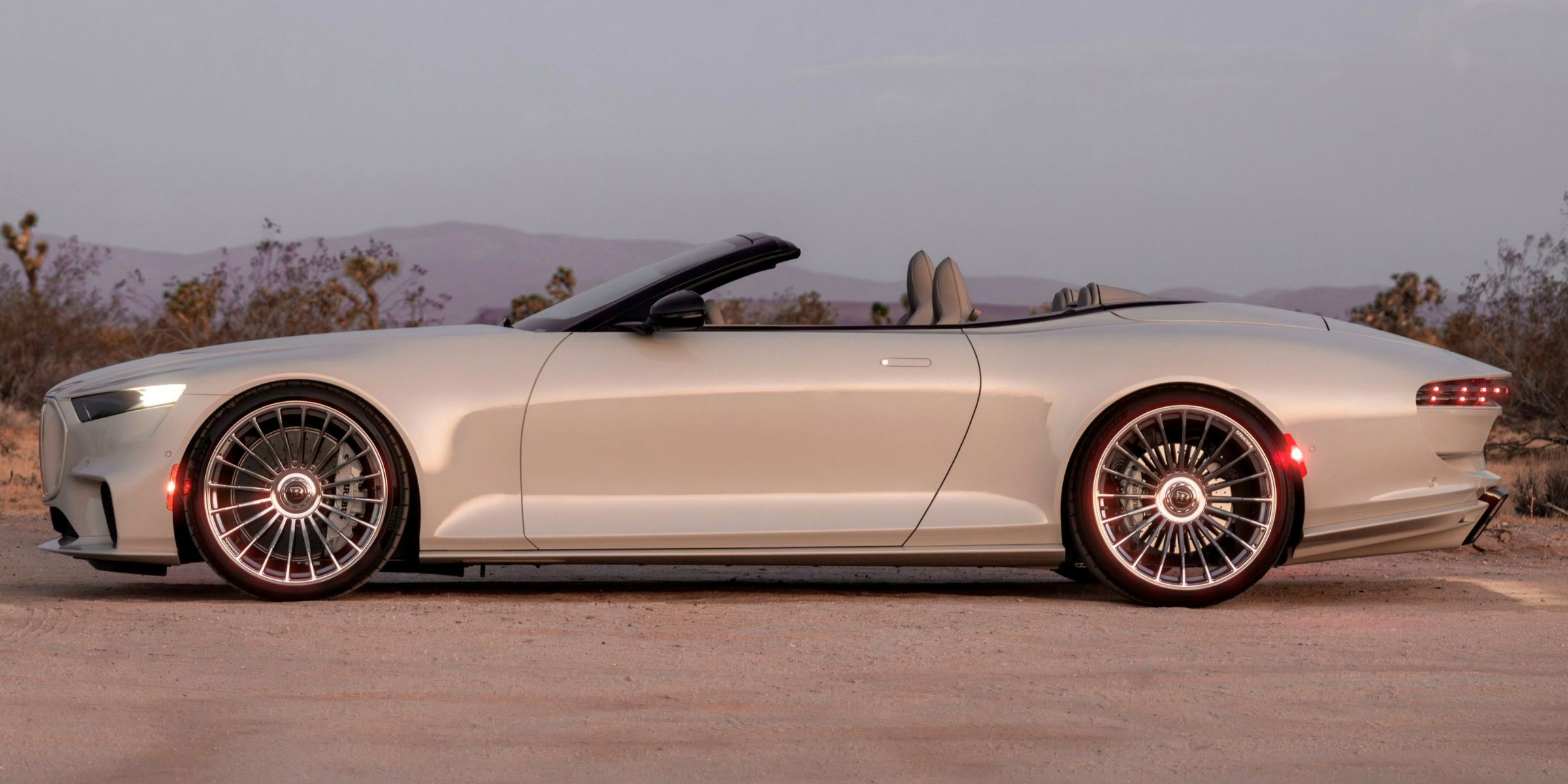
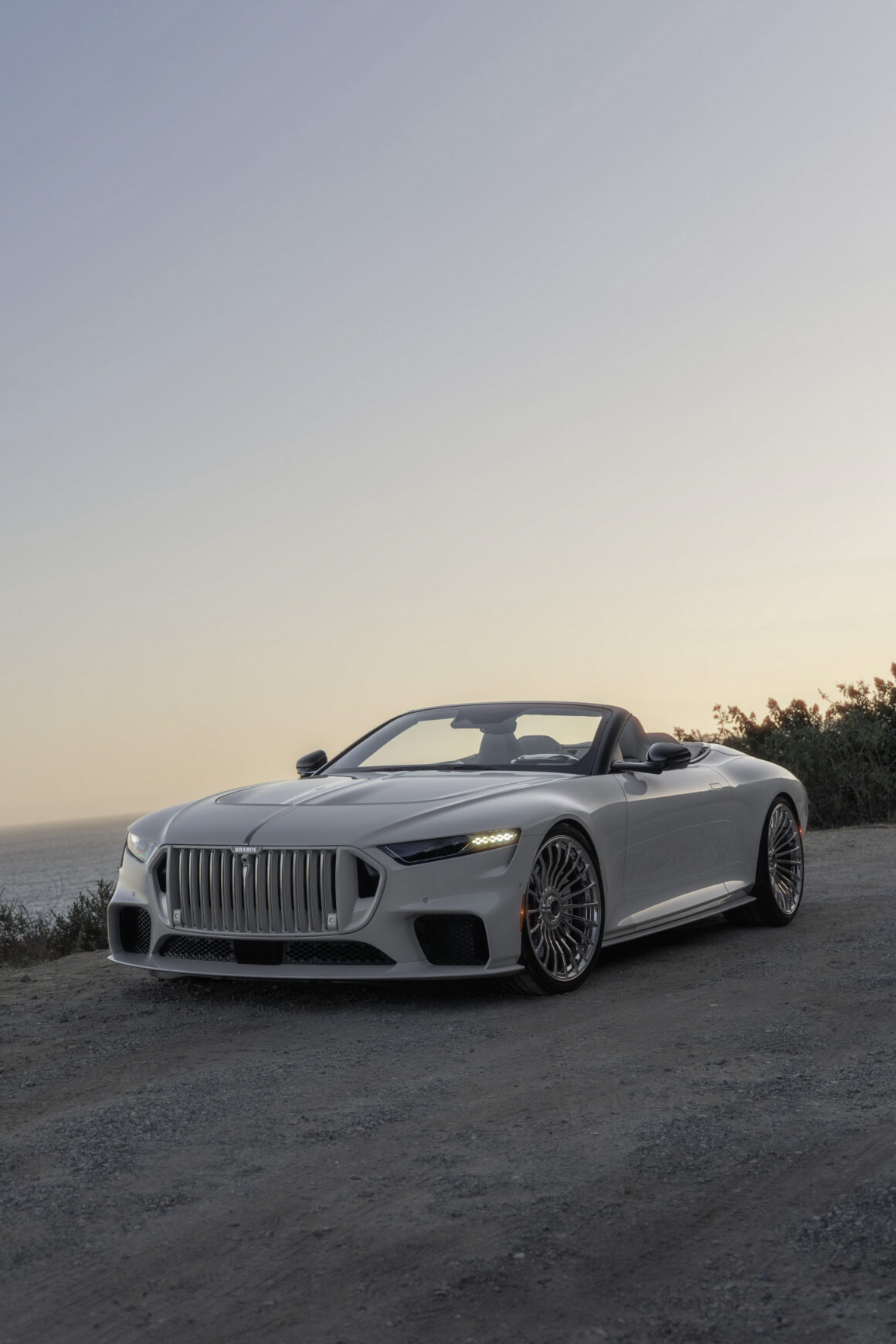
The BODO CABRIOLET’s proportions are central to its character. Measuring 5.06 metres long and just 1.31 metres tall, it combines a low roofline with a broad rear stance and a continuous side contour known as the Bodo Line. The entire coachbuilt body is made from carbon fibre using a pre-preg manufacturing process, with components cured under pressure in an autoclave at BRABUS’s own composites facility in Bottrop, Germany.
Aerodynamics are integrated into the design rather than treated as an afterthought. RAM-AIR intakes supply the engine with fresh air, while the front spoiler generates downforce at the front axle. At the rear, an electrically extendable carbon-fibre spoiler deploys in stages according to vehicle speed. During heavy braking above 140 km/h, it can pivot vertically to function as an air brake, increasing aerodynamic drag to support deceleration.
The convertible roof is another carefully considered element. Electrically operated, extensively insulated and capable of opening or closing in less than 15 seconds, it allows the car to shift between enclosed grand touring and open-air driving without compromising its overall design.
Two launch specifications establish distinct personalities. The Piano Black example pairs its dark exterior with a matching black roof, while the Silk Stone version introduces a two-tone black-and-grey Jacquard roof featuring an inverted “77” motif woven into the fabric itself. Rather than being printed onto the surface, the pattern is integrated into the textile, giving the roof a subtle relief effect.
Two Interpretations Of Masterpiece Luxury
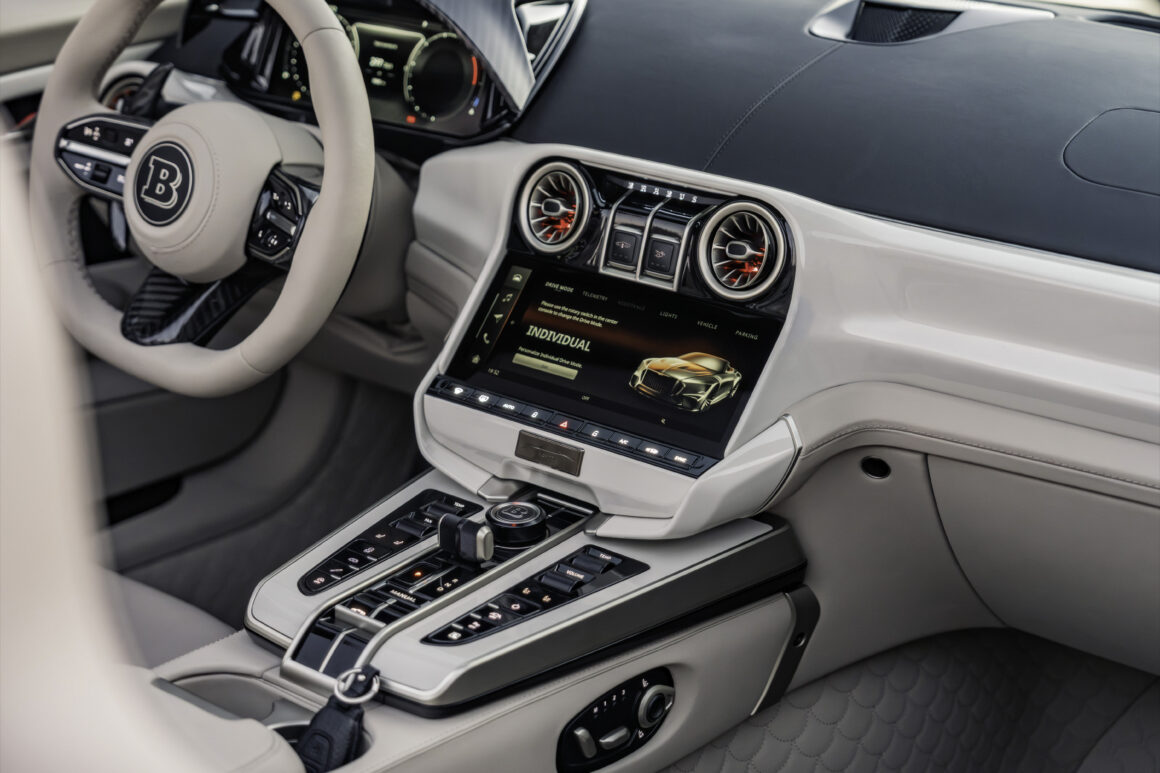
Inside, both launch cars feature the BRABUS Masterpiece cockpit, with their individual characters defined by different colour and material combinations.
The Piano Black specification draws inspiration from Bodo Buschmann’s personal vision of grand touring. Saddle Brown leather sits alongside exposed carbon-fibre components and matte Dark Shadow trim, creating a contrast between traditional luxury materials and contemporary performance detailing.
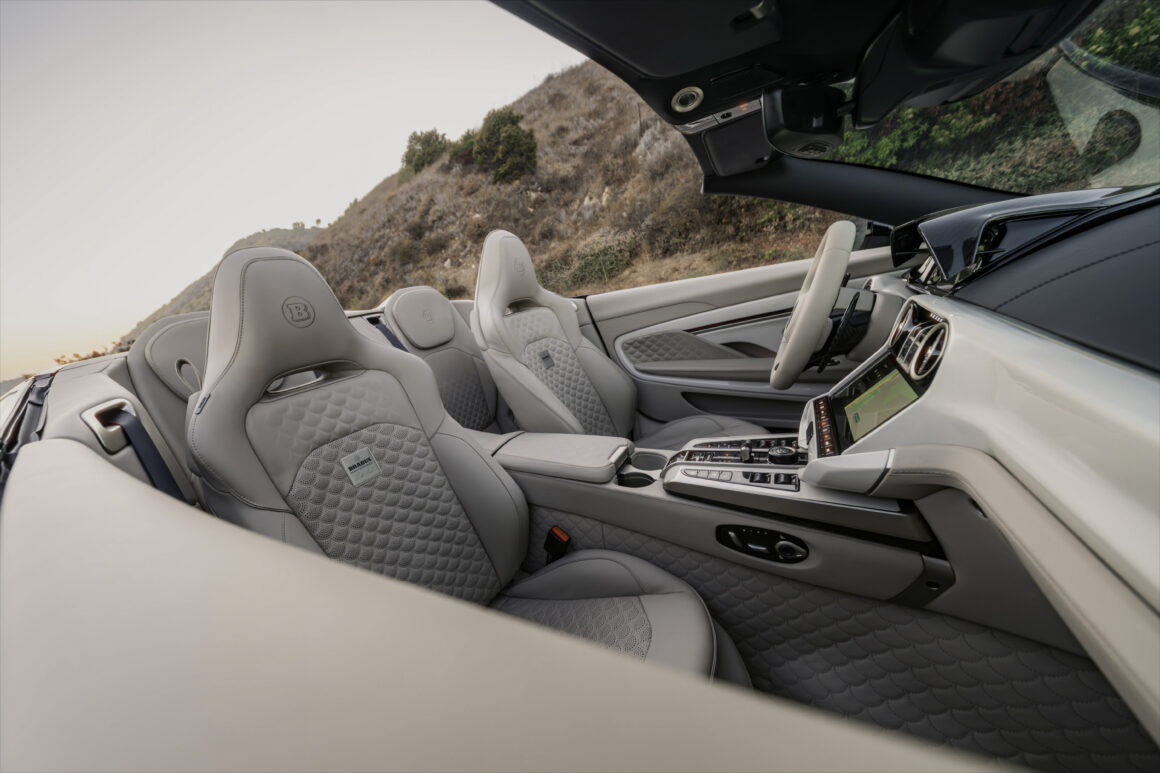
The Silk Stone interpretation takes a more restrained approach. Its exterior colour is carried into the leather, trim and carbon-fibre elements of the cabin, creating a coordinated visual transition from bodywork to interior. Across both configurations, BRABUS’s signature Shell quilting extends beyond the four seats to the cockpit floor, rear deck, luggage compartment and floor mats.
Individual details reinforce the car’s bespoke positioning. The vehicle’s namesake has a signature embroidered into the door panels, while the seatbacks feature a silhouette of the BODO CABRIOLET. Each example also comes with colour-matched keys and a leather BRABUS Weekender bag, extending the specification into the ownership experience.
The wheels receive the same attention. Twenty-two-inch BRABUS Monoblock Z-GT Platinum Edition forged wheels use a 20-spoke concave design, paired with Pirelli P Zero tyres developed specifically for the car. The tyres carry an exclusive “BB” sidewall marking, identifying their connection to the BODO programme.
A Tribute To Bodo Buschmann
The car’s name is more than a branding exercise. Bodo Buschmann founded BRABUS in 1977, building the company around the transformation of high-performance automobiles through engineering, design and individualisation. The BODO project brings that philosophy into a vehicle conceived as a standalone expression of the marque.
Constantin Buschmann has described the cabriolet as a tribute to his father and to a project they discussed repeatedly over the years. The original vision took eight years of work to realise, first through the BODO Gran Turismo Coupé and now through its open-top counterpart.
The number 77 appears throughout the design as a reference to the year BRABUS was established. It also defines the production limit: just 77 BODO CABRIOLET examples will be built worldwide, in a separate series from the coupé. Each car will be manufactured to its owner’s individual specification.
That combination of limited production and personal configuration places the car within a tradition of bespoke automotive manufacturing in which exclusivity is measured not only by numbers, but by how closely each vehicle reflects its owner’s preferences.
The Price Of Exclusivity
BRABUS lists the BODO CABRIOLET at a starting price of €1,077,000, excluding German VAT. At an indicative exchange rate of approximately R18.53 to the euro, that translates to about R19.95 million, or roughly R20 million.
That conversion is a reference point rather than a South African retail price. Local taxes, import costs, shipping, duties and any market-specific specification would affect the final cost of bringing an example into the country.
At this level, the BODO CABRIOLET competes in a rarefied segment where performance figures are only part of the proposition. Its appeal rests equally on the V12 configuration, the carbon-fibre coachwork, the Masterpiece interior, the limited production run and the story behind its name.
The BRABUS BODO CABRIOLET is ultimately an expression of a particular philosophy of luxury: unapologetically powerful, deliberately individual and built around the idea that a car can carry a legacy as well as a specification.
For BRABUS, the open roof changes the experience, but not the ambition. The BODO CABRIOLET brings a long-held vision into the present, giving the brand’s founder a fitting tribute in the form of a machine designed to be heard, seen and remembered.