The Whitney Museum’s Like New revisits the Pop artist’s fascination with repetition, appropriation and mass imagery — and asks what happens when the image duplicator becomes the image being duplicated.
Roy Lichtenstein understood the power of the image long before the image became the dominant currency of contemporary culture.
His paintings borrowed from comic books, advertisements, art history and popular visual language, stripping images down to their essential graphic components and rebuilding them at monumental scale. Decades later, the irony is difficult to miss: an artist who spent his career appropriating images has himself become one of the most reproduced artists of the modern era.
The Whitney Museum of American Art’s Roy Lichtenstein: Like New, on view in New York through May 10, 2027, returns to that tension. Rather than presenting Lichtenstein simply as the cheerful master of Pop Art, the exhibition looks more closely at the colder, more deliberate mechanics behind his pictures: repetition, appropriation, duplication and the strange distance between an image and what it represents.
The Image Duplicator
The story begins with a disagreement.
In 1963, artist Erle Loran attacked Lichtenstein over Portrait of Madame Cézanne, a work that appropriated Loran’s own diagram analysing Paul Cézanne’s Portrait of Madame Cézanne. Lichtenstein retained the basic structure of the diagram, including the black outline, letters and arrows indicating Cézanne’s compositional decisions.
For Loran, the problem was obvious. Lichtenstein had copied his work.
In an Artforum essay pointedly titled “Cézanne and Lichtenstein: Problems of ‘Transformation,’” Loran placed Lichtenstein’s painting beside his original diagram, challenging the idea that the painting represented any meaningful transformation.
His criticism was technically difficult to dismiss. Lichtenstein had indeed copied the image, although he altered elements of the original diagram, including the outline and arrows.
But that was precisely where Lichtenstein’s work became more complicated.
The point was not necessarily to transform the source into something entirely new. It was to take an existing image, move it into another context and see what happened to its meaning.
A diagram created as an analytical tool could become a painting. Once it occupied the gallery wall, its relationship to Cézanne changed. What had previously functioned as criticism and scholarship could suddenly resemble something closer to anti-art.
The copy had become a new kind of object.
Copying As A Strategy
Lichtenstein would continue to work this way throughout his career.
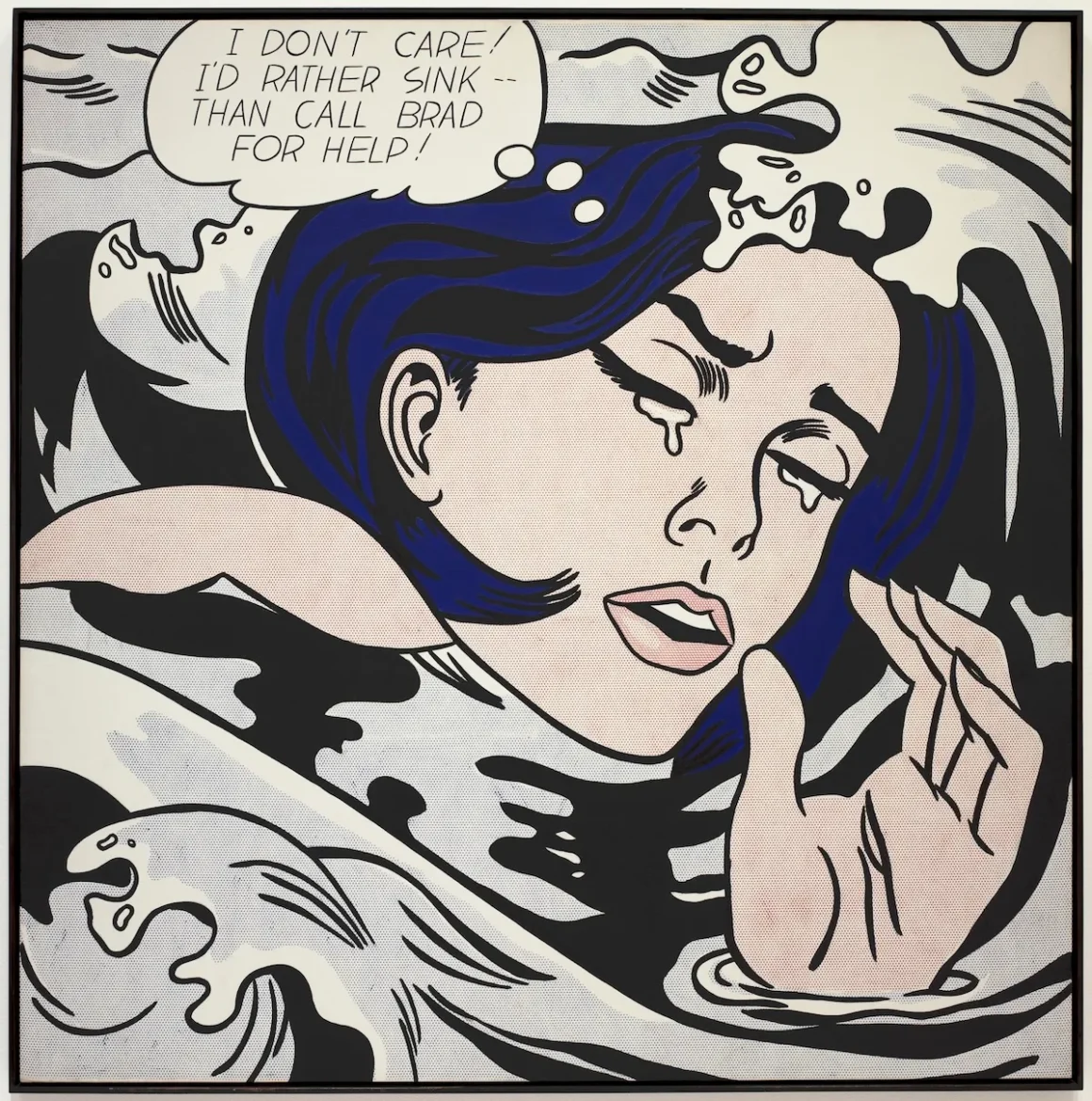
He borrowed from Henri Matisse and Pablo Picasso. He looked to advertisements, comic books, appliances and medical imagery. He appropriated emotionally charged comic-book scenes and transformed individual frames into large, meticulously constructed paintings.
The sources were familiar. The treatment was anything but casual.
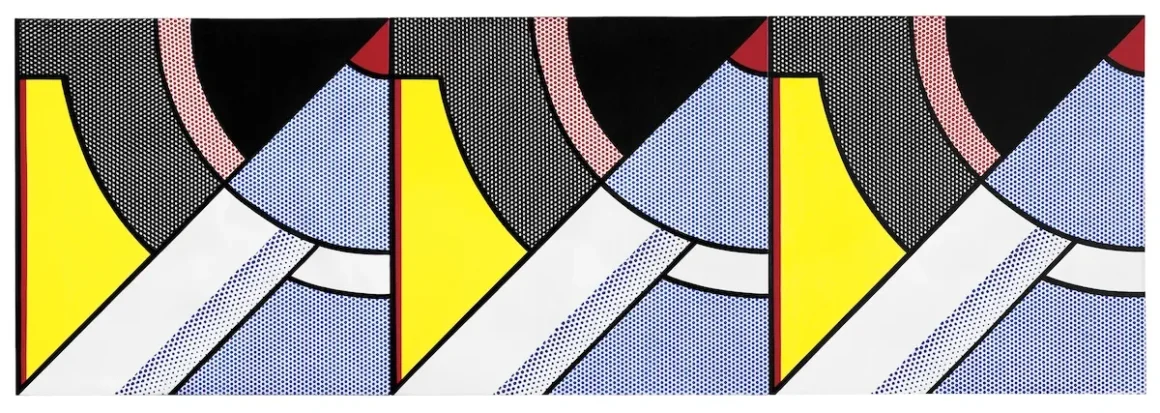
His signature Ben-Day-style dots, hard outlines and flat areas of colour made the images immediately recognisable, while simultaneously creating distance from their original contexts. A comic-book panel could become monumental. A commercial image could become an object for contemplation. A brushstroke — traditionally evidence of an artist’s physical gesture — could itself become something depicted.
That distinction was central to Lichtenstein’s practice.
He was not simply reproducing images. He was making pictures about pictures.
From Cézanne To Comic Books
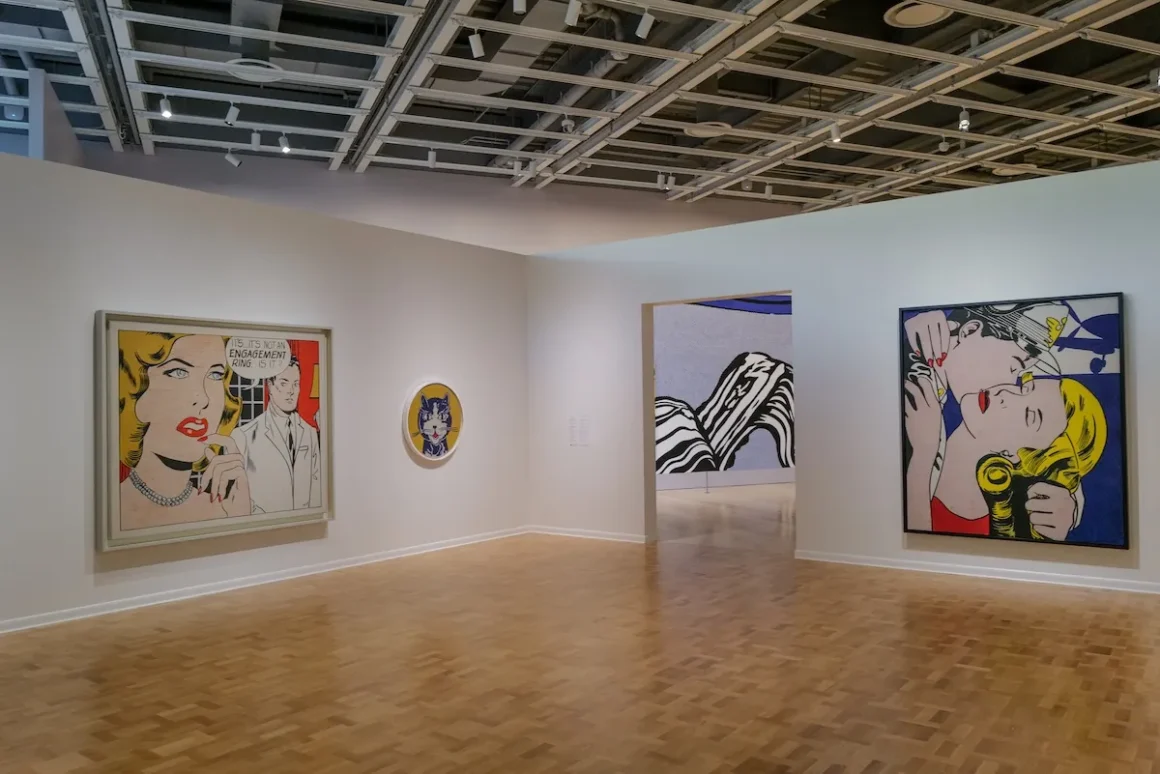
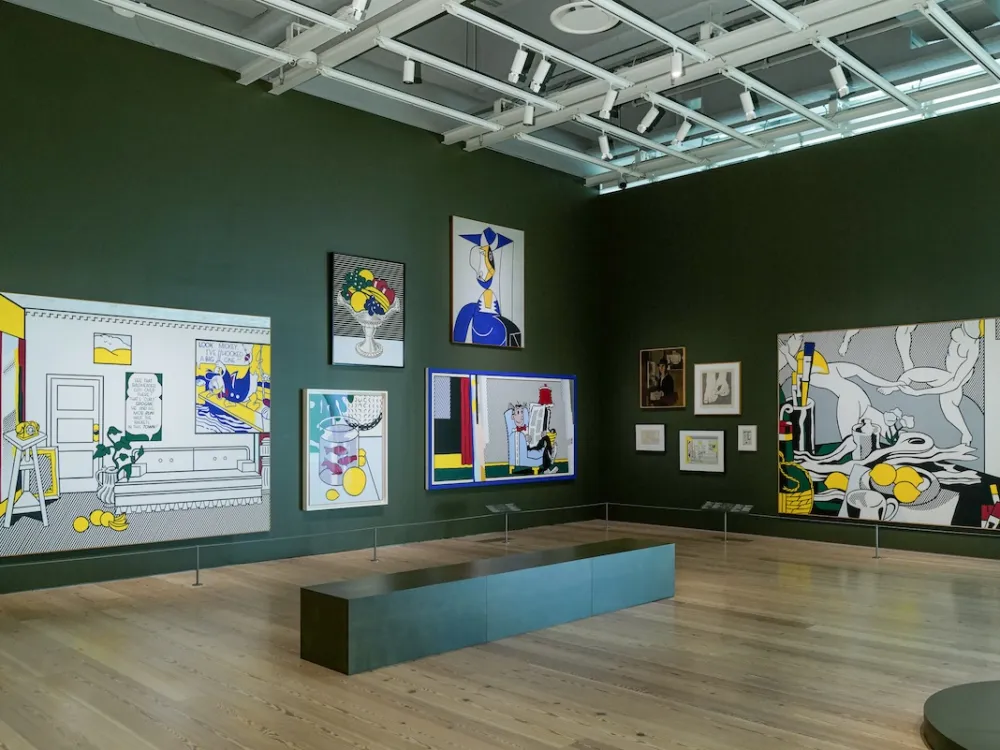
The Whitney exhibition makes that strategy visible across different periods of Lichtenstein’s career.
Among the early works is Golf Ball from 1961, in which the familiar surface of a golf ball is constructed through rows of carefully arranged crescents. The work also plays against the visual purity of modernist abstraction, recalling the formal language associated with Piet Mondrian while bringing it into the territory of popular imagery.
His later paintings based on Claude Monet’s Rouen Cathedral series take another canonical subject and push it through the machinery of mechanical-looking reproduction. The cathedral becomes submerged beneath fields of dots, turning an Impressionist meditation on light into something that appears almost digitally manufactured.
Lichtenstein was effectively taking the visual vocabulary of high art and putting it through the same system as the images found in newspapers, advertisements and comic books.
The hierarchy itself became part of the joke.
The Image Duplicator Becomes The Image
One of the most revealing works in the exhibition is Image Duplicator from 1963.
Two enormous eyes stare outward beneath raised eyebrows, accompanied by a comic-book speech bubble asking: “What? Why did you ask that? What do you know about my image duplicator?”
The work is itself an appropriation, drawing separately on imagery from X-Men and My Greatest Adventure. Yet neither source is reproduced faithfully.
That distinction matters.
Lichtenstein’s paintings can look like straightforward copies at first glance, but the exhibition repeatedly demonstrates that the artist was manipulating his sources. He selected, cropped, simplified, enlarged and recontextualised them.
The process was less mechanical than it appeared.
And Like New takes that idea one step further by making Lichtenstein himself the subject of appropriation.
The Artist Who Became The Image
Alongside Lichtenstein’s originals, the Whitney presents works by artists including Richard Pettibone and Sturtevant, as well as a photograph by Louise Lawler.
The effect is deliberately recursive.
Lichtenstein copied images.
Other artists copied Lichtenstein.
The Whitney now displays those copies alongside the originals.
The exhibition even reconstructs Lichtenstein’s 1962 debut at Leo Castelli Gallery, reproducing the atmosphere of the original presentation so closely that the parquet flooring has been recreated.
It becomes difficult to determine where the original exhibition ends and its reconstruction begins.
That uncertainty is central to the experience.
A Culture Built On Repetition
Lichtenstein’s work feels particularly relevant now because contemporary visual culture has become almost impossible to separate from repetition.
Images circulate constantly. They are reposted, cropped, remixed, enlarged, filtered, commodified and returned to the public in new forms. An image can move from a painting to a screen, from a screen to clothing, from clothing to advertising and back again.
Lichtenstein recognised the cultural power of that process decades ago.
His own work has subsequently undergone precisely the transformation he explored. His dots, comic-book language and graphic compositions have become part of a visual vocabulary reproduced across everything from posters and merchandise to fashion and commercial design.
The artist who examined the culture of copying eventually became one of its most recognisable images.
That is perhaps the great irony of Lichtenstein’s career.
Before Pop
Like New also looks further back, to Lichtenstein’s years as a graduate student at Ohio State University in the 1940s.
There, he encountered the Visual Demonstration Center of Hoyt L. Sherman, where students studied projected images in darkened rooms as part of an investigation into perception and what Sherman described as “perceptual unity.”
The experience offers an intriguing origin story for an artist who would later become so preoccupied with the construction and reproduction of images.
Before Lichtenstein began borrowing comic strips and advertisements, he was already thinking about how images are perceived, processed and understood.
The Pop paintings did not emerge from nowhere.
The Coldness Beneath The Surface
For all their bright colours and apparent accessibility, Lichtenstein’s paintings can feel remarkably detached.
That quality is easy to overlook.
The reds, yellows, blues and dots create an immediate visual pleasure, but beneath them sits a more analytical approach. The Whitney’s curators describe this quality as a form of “conceptual detachment,” and it helps explain why Lichtenstein’s work can feel so different from the exuberance normally associated with Pop Art.
There is something deliberately impersonal about his images.
Even the famous crying women and romantic comic-book scenes are presented with an emotional distance that makes their apparent melodrama strangely cold.
That distance gives the work its edge.
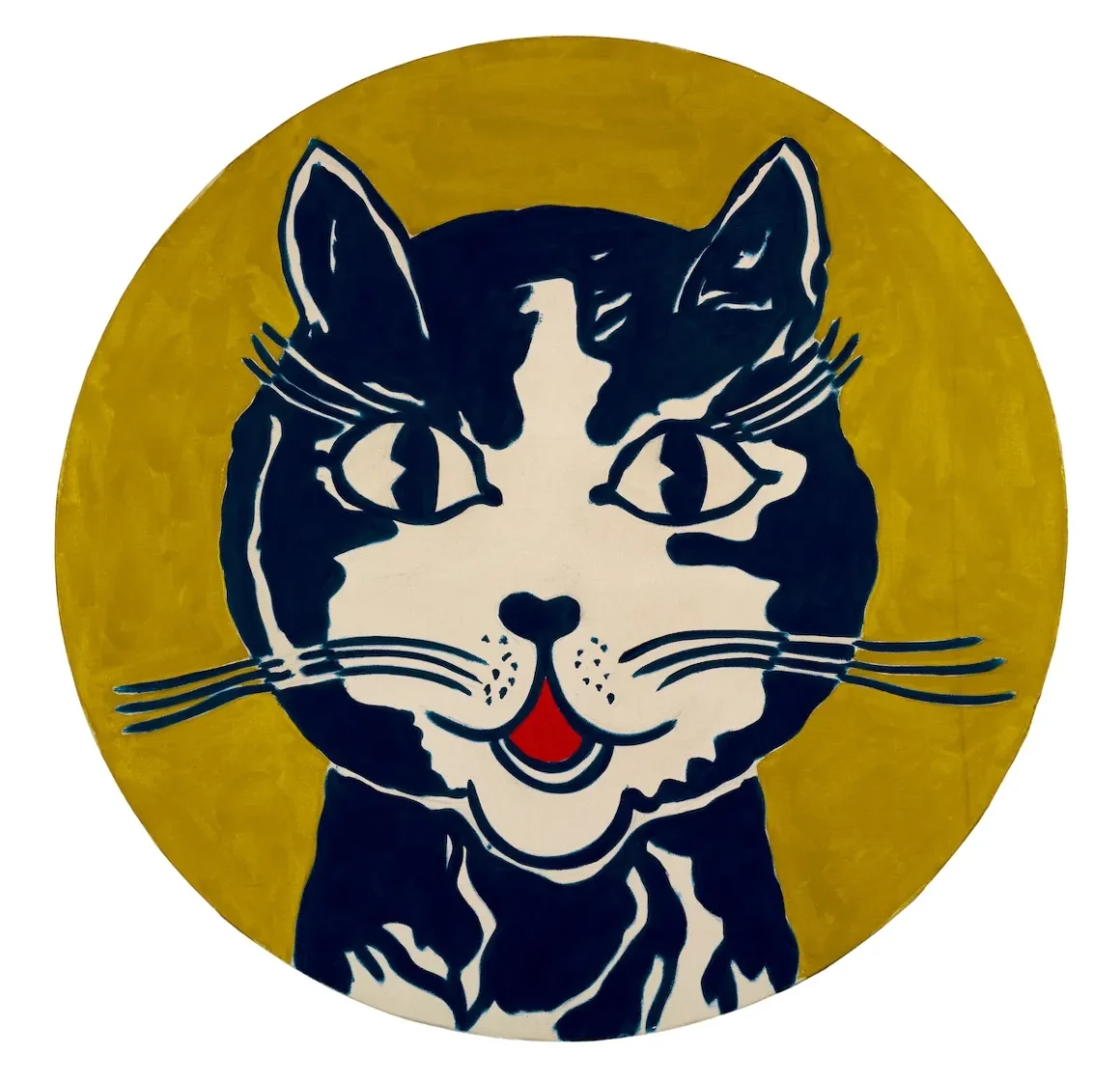
The Copy As The Original
The Whitney’s exhibition ultimately turns Lichtenstein’s central question back onto his own career.
If an image can be copied, enlarged and moved into another context, where does its meaning reside?
Is it in the original source? The artist’s intervention? The new context? Or in the viewer’s recognition of what has been borrowed?
Lichtenstein never offered a simple answer.
Instead, he made the question itself part of the work.
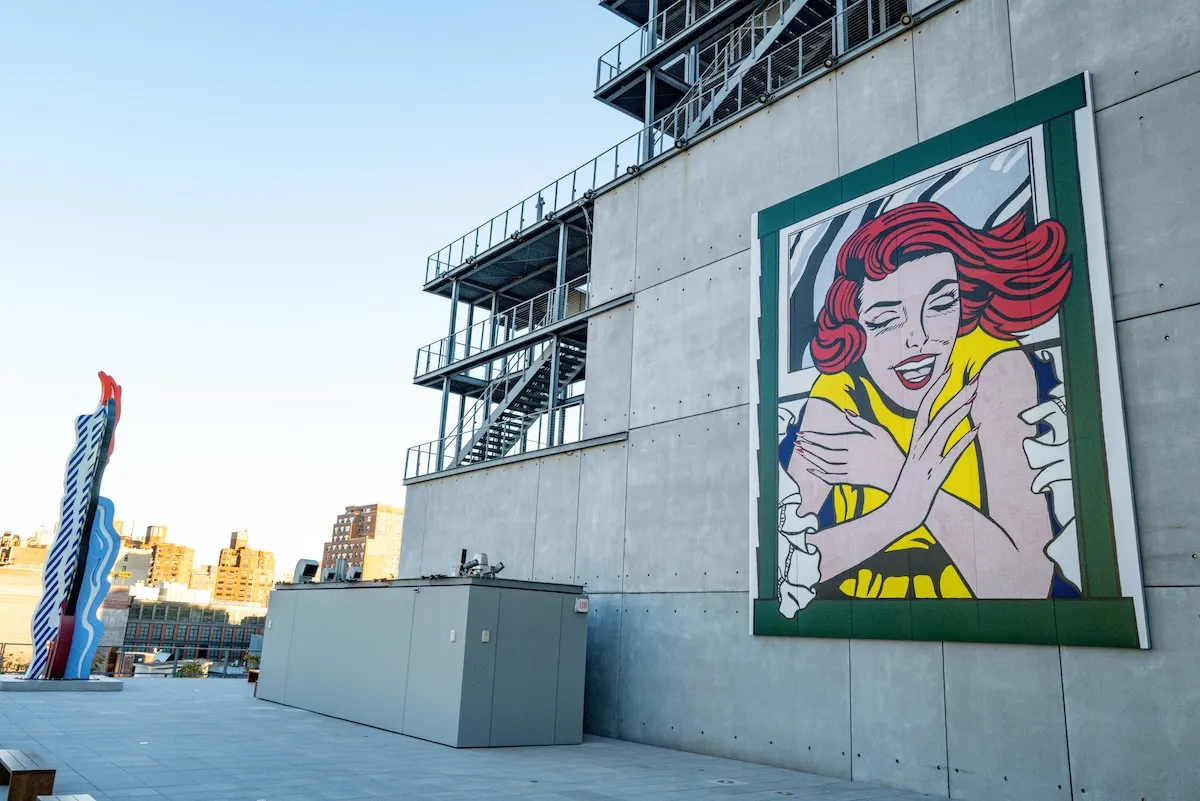
Outside the Whitney, that question continues on the museum’s façade, where Alex Da Corte and his studio assistants have recreated Lichtenstein’s mural from the 1963 New York World’s Fair. The enormous remake transforms the artist’s own image once again, enlarging it to roughly 32 feet and turning reproduction into both homage and reinterpretation.
It is another copy.
But by this point, the distinction feels almost beside the point.
Lichtenstein spent his career showing that images acquire new lives as they move between contexts. Like New suggests that his own work has followed the same path.
The artist became the image. The image became the reference. The reference became the copy.
And somewhere inside that endless cycle, Roy Lichtenstein’s original question remains: what happens to an image when we see it again?