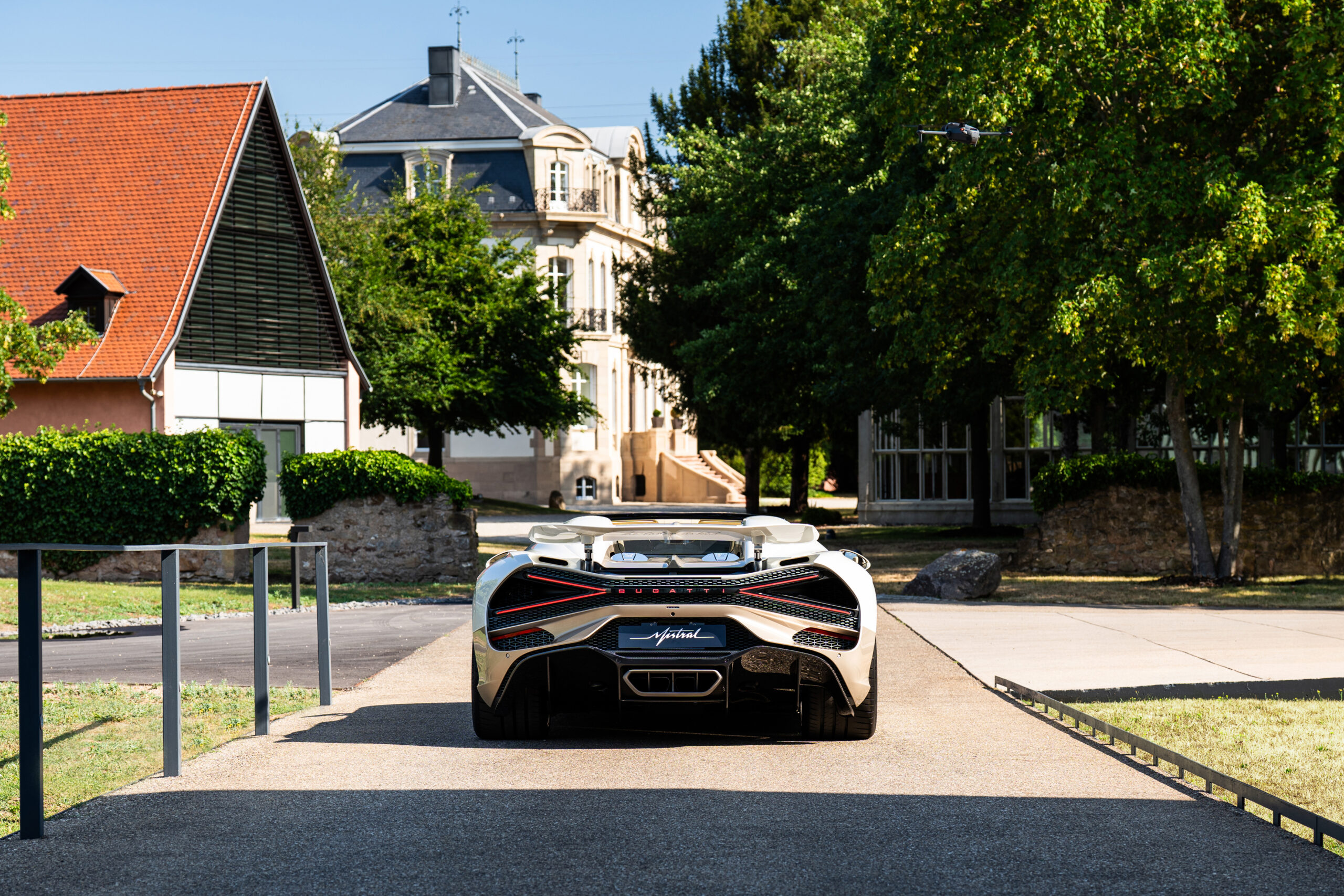
Every automotive era eventually reaches its final chapter. For Bugatti, that moment arrives with the delivery of the last Mistral—a hypercar that not only celebrates astonishing performance but also bids farewell to one of the most remarkable engines ever created.
After two decades of redefining what was mechanically possible, Bugatti has officially retired its legendary W-16 engine.
The French marque has unveiled the 99th and final Bugatti Mistral, making it the last series-production Bugatti to leave the company’s historic atelier in Molsheim powered by the iconic quad-turbocharged 8.0-litre W-16.
For collectors, it represents far more than the end of a production run—it marks the close of one of the most influential chapters in modern automotive history.

The Engine That Changed Hypercars Forever
Producing an extraordinary 1,578 horsepower and 1,600 Nm of torque, the W-16 remains one of the most ambitious engines ever installed in a road car.
Its performance figures remain staggering even by today’s standards.
The Mistral accelerates from 0 to 100 km/h in just 2.4 seconds before reaching an astonishing 453 km/h, making it the fastest open-top production car ever built—a record secured in 2024 by the Mistral World Record.
Yet its significance extends well beyond outright speed.
Since Volkswagen Group revived Bugatti in 1998, every modern Bugatti—from the groundbreaking Veyron to the Chiron and their numerous special editions—has been defined by the unmistakable presence of the W-16.
The engine became more than a powertrain.
It became the heart of Bugatti’s identity.

A Collector’s Farewell
Appropriately named “The Last of Its Kind,” the final Mistral has been finished in an elegant combination of Pearl and Sparkle, while the cabin features Magnolia leather, Grey Carbon Matt finishes and embroidered signatures of Bugatti founder Ettore Bugatti on each headrest.
Every detail reflects the exclusivity expected of a car carrying such historic significance.
With a reported price of approximately US$5 million—around R80 million at current exchange rates before South African taxes and import duties—the final Mistral is as much a collector’s artefact as it is a hypercar.

The Beginning of a New Chapter
The retirement of the W-16 also signals Bugatti’s transition into a new era.
The marque’s next flagship, the Tourbillon, replaces the iconic quad-turbocharged engine with an all-new naturally aspirated V-16 hybrid powertrain developed in partnership with Rimac. The new architecture combines a high-revving sixteen-cylinder engine with three electric motors, embracing electrification while preserving the drama and engineering excellence that define the Bugatti name.
It is a bold evolution rather than a departure.

Not Quite the Final Goodbye
Although the Mistral closes the chapter on series-production W-16 models, the engine may still live on in exceptionally rare commissions.
Through Programme Solitaire, Bugatti’s bespoke division dedicated to one-off and ultra-limited creations, select collectors can still commission vehicles powered by the legendary engine. The recently revealed Brouillard and FKP Hommage are among the first examples of this exclusive programme.
For the wider world, however, the final Mistral represents the end of an engineering icon that reshaped the hypercar landscape for more than twenty years.
Few engines have inspired as much admiration—or rewritten the limits of performance—as Bugatti’s extraordinary W-16.