|
Getting your Trinity Audio player ready...
|
More than 500 timepieces and objects will take over Milan’s Palazzo delle Scintille this October, offering an extraordinary look at the maison’s history, craftsmanship and most complicated creations.
There are exhibitions, and then there are exhibitions designed to make an entire city stop and look.
This October, Patek Philippe will bring its Watch Art Grand Exhibition to Milan, staging what will be the largest edition of the travelling showcase in the maison’s history.
From 2 to 18 October, the exhibition will occupy Milan’s recently renovated Palazzo delle Scintille, beneath its striking 30-metre-high dome. Across approximately 2,900 square metres and 15 themed rooms, visitors will encounter more than 500 timepieces and objects, spanning the history, craftsmanship and technical achievements of one of Switzerland’s most revered watchmakers.
For a maison that has traditionally resisted the noise and celebrity culture surrounding luxury, the exhibition represents something particularly interesting: an opportunity to experience Patek Philippe beyond the watch itself.
The Watch Art Grand Exhibition was first staged in Dubai in 2012. Since then, the concept has travelled to cities including London, New York, Tokyo and Munich, attracting more than 165,000 visitors.
Milan now becomes its seventh destination.

A city with a particular connection
The choice of Milan feels deliberate.
Italy occupies an important position within global watch culture, but its influence extends far beyond horology. The country’s longstanding relationship with art, architecture, fashion and design makes it a natural setting for an exhibition built around craftsmanship.
Patek Philippe also has a historical connection to Italy that stretches back to the earliest years of the maison.
Founded in Geneva in 1839, Patek Philippe sold one of its first watches to a client in Rome. That connection will be reflected in Milan through a selection of historic pieces from the Patek Philippe Museum.
Among them will be an enamelled, gem-set pocket watch dating to 1897 that belonged to King Umberto I of Savoy, alongside an earlier piece from 1830 featuring a champlevé enamel map of northern Italy.
Thierry Stern, president of Patek Philippe, has previously described Italian clients as having a particular appreciation for design, fashion and an avant-garde spirit — qualities that have made Italy an important market for the maison.

The extraordinary, under one roof
For visitors, the exhibition will offer access to the breadth of Patek Philippe’s world.
The maison’s contemporary collection will be presented alongside some of its most technically ambitious creations, including the iconic Nautilus and Aquanaut, as well as watches incorporating some of the most complex complications in mechanical watchmaking.
At the centre of this exploration will be the Super Complications room.
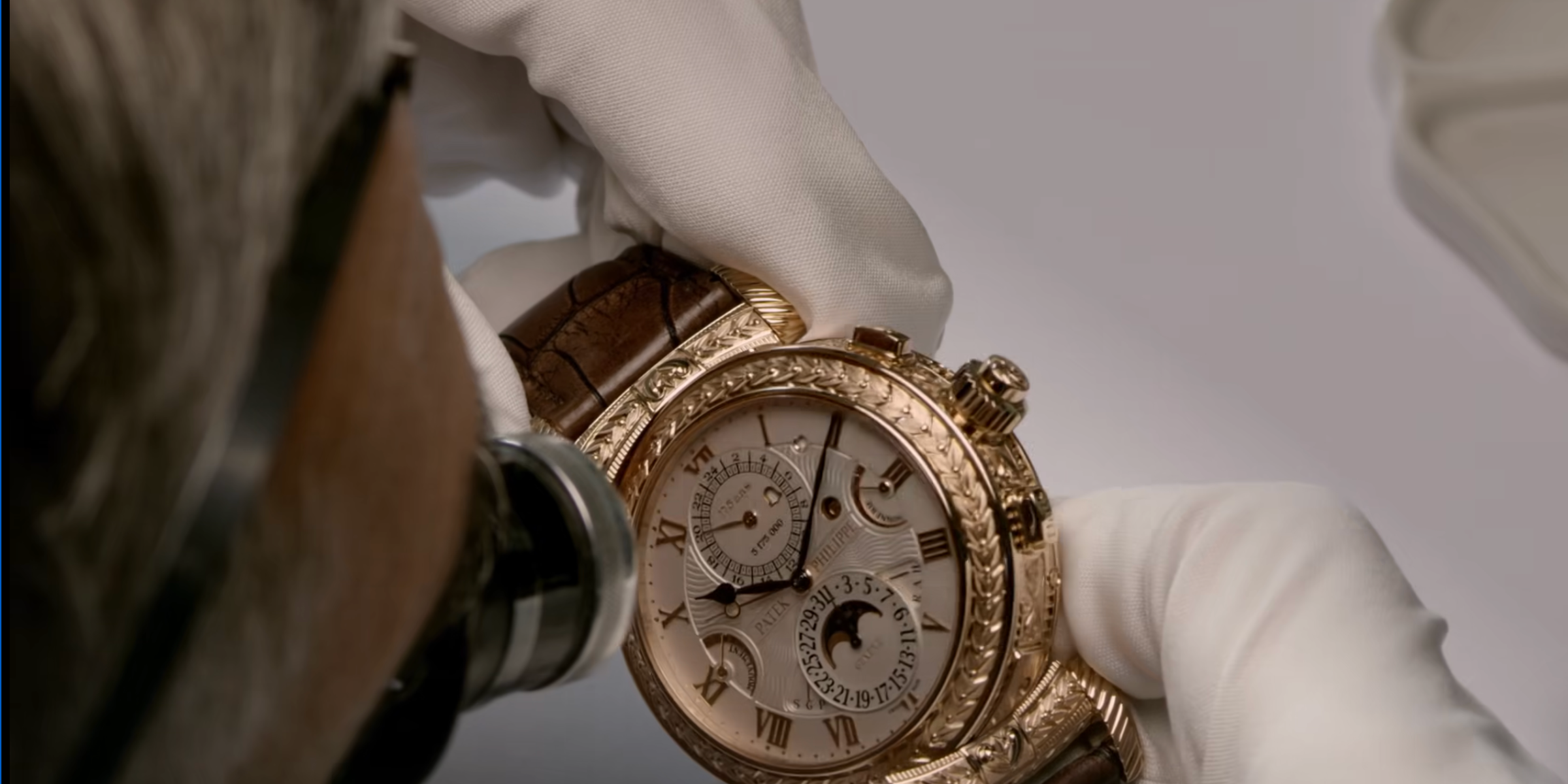
Three extraordinary pieces will take their place together: the Calibre 89, created for Patek Philippe’s 150th anniversary and incorporating 33 complications; the Grandmaster Chime Ref. 5175, created for the maison’s 175th anniversary and featuring 20 complications; and the Star Caliber 2000.
Together, they offer an extraordinary reminder that haute horlogerie is not simply about measuring time.
It is about asking how far human ingenuity can take a mechanical object.

Where watchmaking becomes art
Perhaps equally compelling is the Rare Handcrafts collection.
Patek Philippe’s métiers d’art traditions bring together techniques including miniature enamel painting, cloisonné enamel, hand engraving, wood marquetry, guilloché and gem-setting.
Twenty-seven Rare Handcrafts pieces will be exhibited in Milan.
Among the highlights is the Burano Pocket Watch, inspired by the Venetian island of the same name. Its elaborate decoration combines cloisonné enamelling in 70 colours with guilloché and paillonné techniques incorporating gold and silver leaf.
Elsewhere, the Sicilian Oranges Dome Clock demonstrates just how far the boundaries between watchmaking, decorative art and craftsmanship can be pushed.
The clock employs 49 different enamel hues, combining transparent, opalescent and opaque enamels with miniature painting. More than ten individual firings, at temperatures between approximately 900 and 910°C, were required during its creation.
The result is less a clock in the conventional sense than an object of decorative art whose mechanism is only one part of its story.

An exhibition about more than watches
That may ultimately be the most interesting aspect of the Watch Art Grand Exhibition.
Patek Philippe could simply display its most valuable or technically impressive watches behind glass.
Instead, the Grand Exhibition places the objects within a larger narrative about heritage, craftsmanship, design, innovation and human skill.
It also turns the experience into a meeting point for collectors, enthusiasts, watchmakers and the wider public.
Previous editions have demonstrated the cultural impact such an event can have.
Collectors have travelled internationally to attend, while watchmakers have demonstrated their craft to visitors. In New York, the 2017 exhibition extended far beyond the exhibition space itself, becoming a visible presence throughout the city.
That is the power of experiential luxury at its most effective: the object remains central, but the experience surrounding it becomes part of the memory.

Milan, your time is now
For Patek Philippe, Milan offers an appropriate stage.
A city synonymous with fashion, architecture, design and cultural sophistication provides a fitting backdrop for a maison whose identity has always rested on the relationship between technical mastery and aesthetic refinement.
For visitors, however, the attraction may be simpler.
For eighteen days, some of the most important creations in Patek Philippe’s history — from historically significant museum pieces to contemporary masterpieces of mechanical complexity and rare handcraft — will be brought together under one roof.
Milan, your time is now.