|
Getting your Trinity Audio player ready...
|
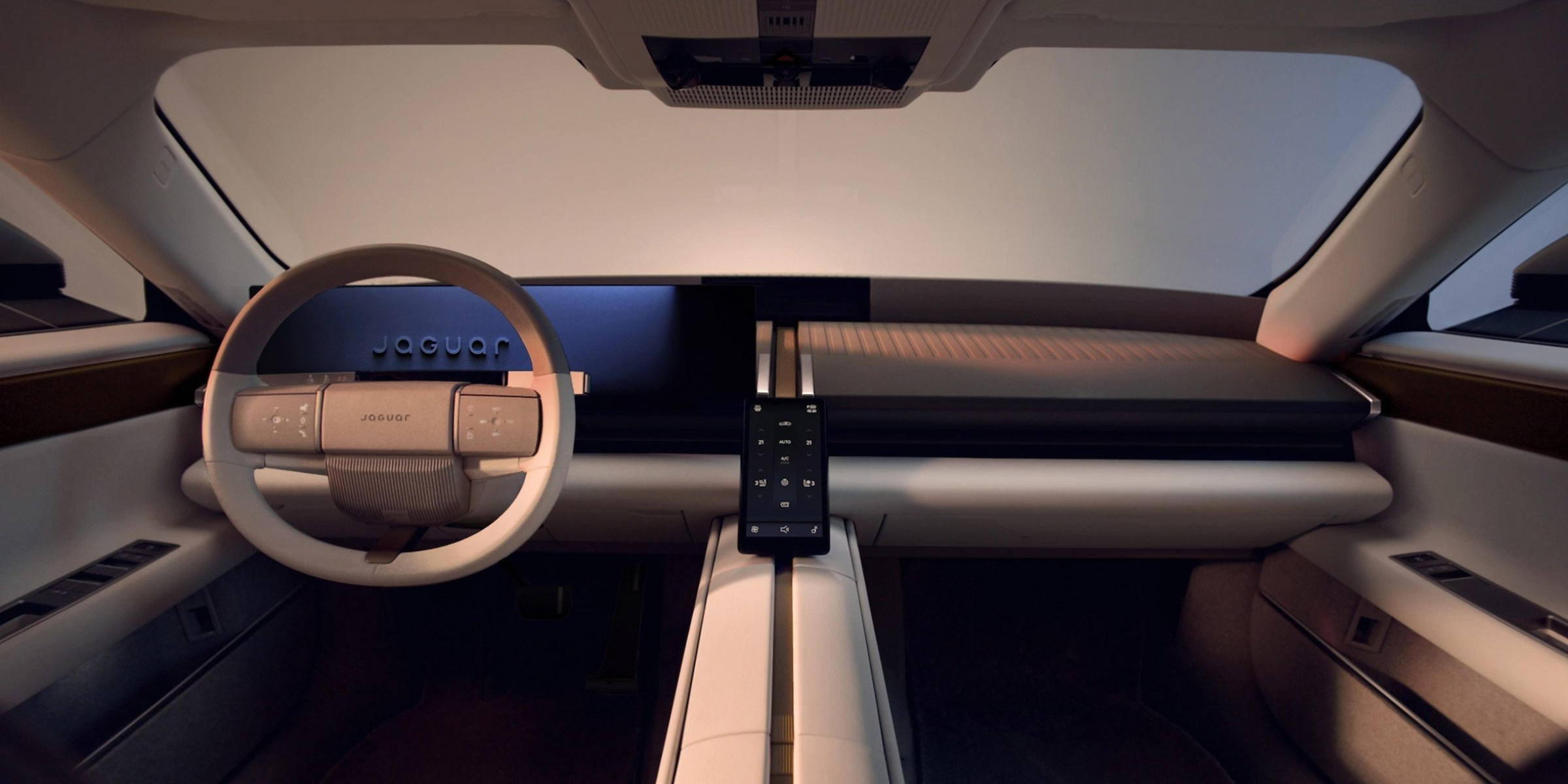
A full-length architectural divider, travertine-inspired tones and restrained technology define Jaguar’s most radical production interior yet.
With the exterior of the Jaguar Type 01 still concealed beneath camouflage, its interior is offering the clearest indication yet of how much of the provocative Type 00 concept will make the transition from concept car to production.
The answer appears to be: quite a lot.
At the centre of the cabin is a broad, full-length spine running from the dashboard through to the rear of the four-seat grand tourer. Rather than functioning simply as a console, the structure becomes the defining architectural element of the interior, dividing the cabin into four individual zones.
Jaguar Chief Interior Designer Thomas Holden describes it as “an architectural statement that creates four individual spaces.”
It is an unusual approach to automotive interiors, where dashboards and screens traditionally dominate the visual experience. Here, Jaguar has instead chosen to make the architecture of the cabin the primary statement.
The spine rises between the seats, with broad surfaces wrapping around the occupants and reinforcing the car’s low driving position. From above, the effect is particularly striking: rather than one continuous passenger compartment, the cabin reads as a sequence of individual spaces connected along a central axis.
The result is a more intimate, almost cocoon-like environment.

Travertine becomes a colour language
The material language of the Type 00 concept also survives, although in a more production-oriented form.
Where the concept used genuine travertine and brass within the cabin, the Type 01 translates those references into a tonal palette inspired by the appearance of the stone, while the central spine adopts a brass-inspired finish.
That metallic treatment continues along the upper sections of the doors, where elongated inserts incorporate Jaguar’s Leaper graphic.
Textile surfaces soften the otherwise architectural geometry, introducing warmth into an interior defined by strong horizontal and longitudinal lines.
Jaguar has also used these lines to create a visual relationship between the interior and exterior.
A graphic element near the base of the windscreen appears to extend the bonnet into the slim dashboard, while similar linear details are repeated across the doors.
The effect is deliberate: the interior inherits the stretched proportions of the exterior rather than feeling like a separate environment contained within the car.

Technology takes a step back
Perhaps the most interesting aspect of the Type 01 interior is what Jaguar has chosen not to emphasise.
Screens remain present, but they are deliberately integrated into the architecture rather than becoming the architecture themselves.
A digital ClearSight rear-view display sits centrally at the base of the windscreen, aligned with the height of the door mirrors. A slim touchscreen is integrated into the centre console, while a larger display can be seen behind the two-tone steering wheel.
Jaguar is reserving the complete instrument-panel reveal for the car’s official unveiling.
That restraint allows the central spine to remain the dominant visual feature.
Storage is concealed, maintaining the clean surfaces, while a glass roof extends over the cabin and the central console continues between the rear seats.
There is, inevitably, a practical trade-off.
Giving such a substantial amount of space to the central divider means sacrificing some of the openness normally associated with a large four-door GT. But that sacrifice appears intentional.
Jaguar isn’t simply dividing the cabin.
It is making separation part of the luxury experience.
Each passenger receives a defined space rather than simply occupying one of four seats in a shared environment.

From Type 00 to Type 01
The Type 01 represents Jaguar’s transition from the dramatic Type 00 concept towards a new production era.
It will become the first production Jaguar based on the company’s dedicated Jaguar Electric Architecture (JEA) and is expected to feature a tri-motor powertrain producing more than 1,000 PS and over 1,300 Nm of torque.
Before the production car is fully revealed, a camouflaged prototype is making an appearance during Monterey Car Week 2026.
The finished four-door GT is scheduled to be unveiled in New York on October 6, 2026.
But it is the interior that may ultimately tell us the most about Jaguar’s new direction.
The company’s reset has been accompanied by considerable attention to its exterior design language, yet the Type 01’s cabin demonstrates how deeply that philosophy extends beyond the bodywork.
A conventional luxury interior might make technology the centre of attention.
Jaguar has chosen something else.
A sculptural architectural element determines the seating arrangement, controls the sightlines and establishes the rhythm of the entire space. Screens can change. Materials can change. Specifications can change.
The architecture remains.
And that may be the most revealing aspect of the Type 01.
Jaguar isn’t simply designing another electric grand tourer.
It is attempting to redefine what a Jaguar interior should feel like — less like a traditional automobile cabin and more like a carefully composed architectural space.
Project Information
Jaguar Type 01
Brand: Jaguar
Chief Interior Designer: Thomas Holden
Full Reveal: October 6, 2026 — New York