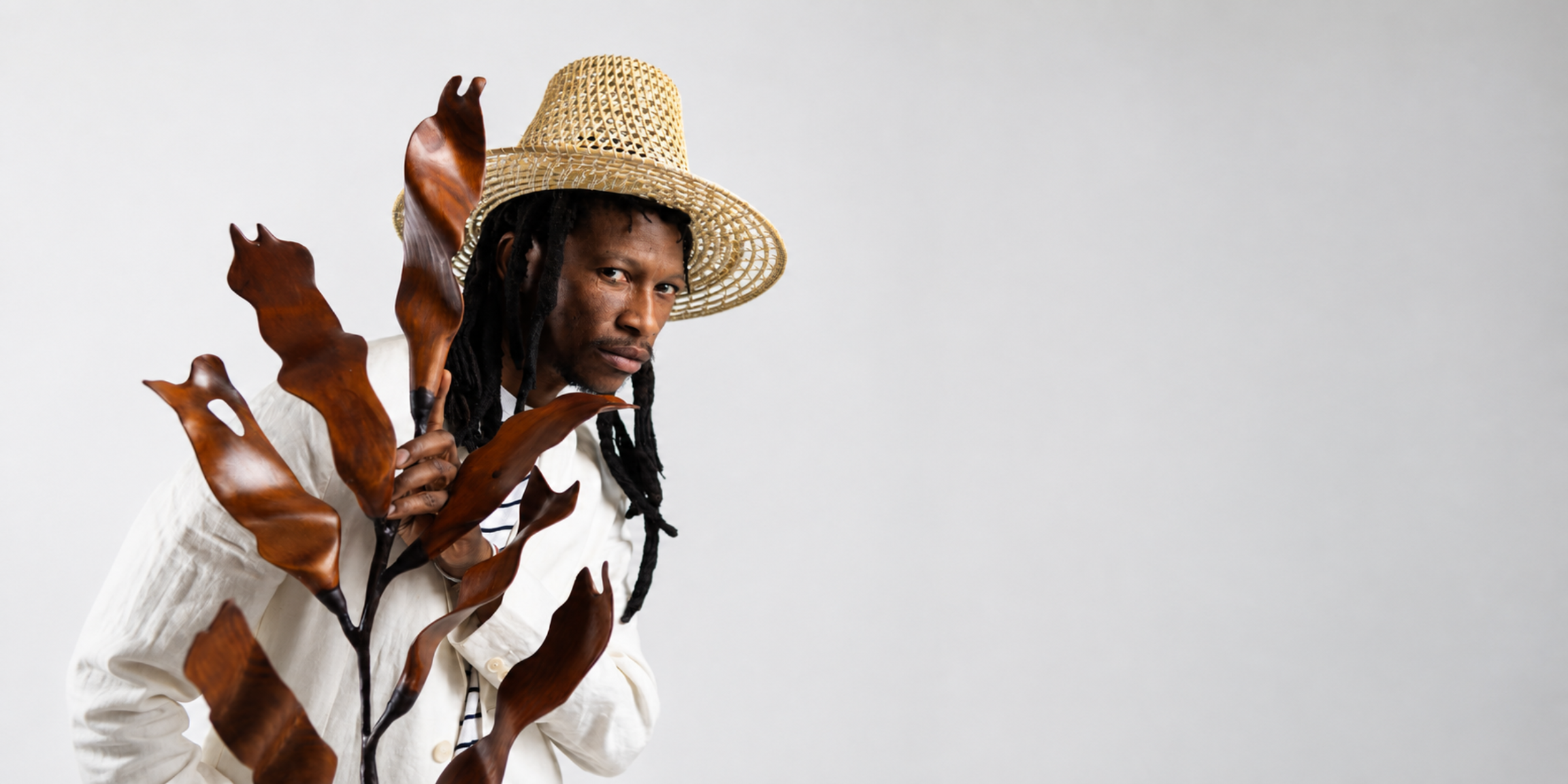
There is a moment, early in any conversation with Atang Tshikare, when the questions stop feeling like an interview and start feeling like an invitation. The Cape Town-based sculptor — whose work now moves between sneaker customization, surface design, sculpture and spiritual archive — has spent a career resisting the labels that usually follow artists of his stature.
From a Christian Dior collaboration built around the constellations of Orion’s Belt to a permanent public installation in a Swedish forest, his practice reads less like a résumé and more like a lineage: one drawn from his father’s collection of African writers, his mother’s eye for beauty, and his own conviction that culture is “multifaceted, like a diamond.” Ahead of new group exhibitions at Iziko Museum and London’s V&A, Grandiose sat down with Tshikare to talk identity, commerce, and the quiet, unglamorous work of knowing oneself.
Your practice moves across painting, sculpture, drawing, design and other creative disciplines. Do you see yourself primarily as an artist, or have you always resisted being defined by a single discipline?
I feel I’m a creative being — that’s what I see myself as. As soon as you say you are “this artist” or “that artist,” people put you in a box and hope you stay in it. For me, everything I’ve done — drawing, graffiti, design, sculpture — has been an expression of life. Every time you meet someone new and different, you absorb a little of them, the part that resonates with you.
I grew up around that range. My father is a cartoonist and a musician who plays saxophone. My mother worked in fashion, makeup and cosmetics, so I knew a lot about beauty from early on. My wife is very academic, but the academia she works in actually works well with what I do. So I’ve never seen myself as a single type of artist, especially not in the English sense of what “art” is. I see a creative person being — that’s it.

There is a very recognisable visual language in your work. Where did that language begin, and how has it evolved over the years?
It started when I was six. I began doing pastel drawings, and I’d even had dreams about things I’m creating now. I actually still have pictures of that early work. I moved into music around seven or eight, then came back to art, and from there I kept exploring — customizing my own clothes and sneakers, transforming things, always as a personal journey rather than something made for an audience.
I became a more serious sculptor in 2015, and that’s when the message became clearer: culture, self, spirit. That’s also when I stopped using English words to name my artworks. Along the way I studied graphic design — not because I wanted to sit in front of a computer, but because I wanted to understand its principles. Once I understood them, I went straight into graffiti, which works against those same principles — art made in the street, in a hurry, in the dark, at risk of being buffed away at any moment.
When I got to Cape Town, I moved into sneaker and clothing customization, working with Adidas and travelling around South Africa doing live events. That taught me something important: art can be limited when it’s tied to a fixed-size object. If someone’s shoe size is an 8, that’s the canvas you’re stuck with. That pushed me into surface design — drawings on furniture, chairs, lamps — and eventually into collaboration with other artists and designers, which is where I really learned the practical, physical side of making things. From there I moved from two dimensions into three. I think the next stage is a fourth dimension, where the creativity isn’t for regular people at all, but for the spiritual world — things that aren’t seen, but felt.
Your work often brings together elements of South African culture, popular culture, nature, spirituality and contemporary life. How do you decide what enters your visual world?
Honestly, I don’t think much about popular culture — I left it behind more than fifteen years ago, when I was still buying and selling clothing, music and art in a store I ran with my wife. What comes into my field of view now comes through instinct and through reading.
My father is a deeply conscious African person, and so is my mother — they read a lot, and he has a collection of African writers: Ngũgĩ wa Thiong’o, Chinua Achebe, and others. Reading those books, and seeing that lineage of creativity, conscientised me. I realised how much Africans have not been included in, and have not been able to express, and that became the fuel for my work.
When I make pieces that speak to me as a Black, Alkebulan, Kemetic, African, Nguni, Setswana person, that’s what I’m drawing from — hence naming things in my own mother tongue, sometimes isiZulu, sometimes Setswana, sometimes Sesotho, because our ancestors don’t come from one lineage alone. Above culture, I’ve come to understand, sits spiritual culture — and the deeper I go into it, the more undefined and purified I become in what I do. My current exhibition, MOWA, is about exactly that: African philosophy of transcendence — not being defined by what’s around you, but transcending toward where you actually belong.

You have worked across both art and design, including collaborations with major international brands. What have these collaborations taught you about the relationship between art, commerce and creative freedom?
Working with institutions of commerce, fashion, art and even education — including Harvard — taught me to always put what’s in my heart first. Even when a brand asks you to do something specific, what they’re really asking is for you to define yourself, because they want their audience to be open to something new. But they already like what you’ve been saying.
With Christian Dior, the piece I made was called Dinaledi — stars. I was talking about the constellation of Orion’s Belt and the origins we come from as Black beings. I put those constellations onto the backrest and seat of a chair, because people who can’t physically see the stars need another way to access them — through feeling, through touch, through sensing.
That kind of work matters more to me than the money. I don’t do things for money — I do them for what needs to be archived, explored, and raised into view for people who’ve been mentally mutilated by what they’ve been told about themselves. Once that spirit has been explored properly, the commerce can follow. I did a permanent public artwork in a forest in Sweden alongside far more established names, for a fee that was genuinely small — but the meaning of the piece, and where it will sit for years to come, outweighed that completely.
Outside of that, I do have a commercial side. Zabalaza is my parent company, and that’s where I make more commercial decisions. Under it, I’ve also started a company called Yarona, where I work purely as a founder, collaborating with artists who aren’t as established as I am.

Johannesburg has played an important role in your creative journey. How has the city influenced the way you see, make and think about art?
Cape Town is actually where I live, and where I’ve been shaped the most — Johannesburg hasn’t been the primary influence, though it mattered at a specific point. I used to buy and sell hip-hop and graffiti-based cultural artifacts there, from people like Osmic, who ran a shop called Ritual Stores, and from Craig Native. That taught me a lot about the business side of what was happening in Johannesburg at the time.
Cape Town is different — slower, in terms of what people want. And that taught me something else: here, I’m not competing with other artists, I’m competing with nature. Cape Town has the ocean, the rivers, the mountains, the caves — places people can enjoy for free, safely, at almost any hour. People here also travel a lot, so they see a lot of other art. So I’ve learned to make the best of the best, because I’m up against everything nature offers for free. That’s why I focus on work that feels like it belongs in nature, or in your dreams — places where people feel calm, at rest, with something beautiful to think about.

When you create a new work, how much of it is planned and how much is discovered during the process?
I don’t really think of it as a percentage, but if I had to guess, somewhere between 40 and 60 percent is formed upfront — I write things down, draw some of it, think about what I want the piece to say, go to books, talk to my ancestors. The rest comes later, often through communicating with people — mostly non-artists, since I don’t actually talk to other artists that much. They tell me things — traditions, rituals — and I recognise them in the work, because they were subconscious at the point of creation.
Creating happens with a certain force, and that force carries a vibration that keeps shifting the longer you work with it — even day to day. By the time a piece leaves the studio and enters a gallery, people bring their own week, their own emotions, into it, and what they reflect back to me is often where that remaining 40 to 60 percent of meaning surfaces. It’s rarely as high as 80 percent understood beforehand — occasionally I’ve made a piece and only understood it, fully, afterward. It moves like a wave. I can’t pin it down exactly, but it’s usually somewhere in the middle.

Contemporary African artists are receiving increasing international attention. What do you think the global art world still misunderstands about African creativity?
Mostly, it’s the culture and the spirit — the use and the origins behind the work. Europeans and Americans still view African people in backward ways, so even when they feel the creativity, they don’t believe it can be intentional. I can point to international artists — Matisse, Picasso, and others — who, quote unquote, “borrowed” from South Africa, East Africa, North Africa, because there was a feeling they couldn’t express with words alone. It remains a mystery to them.
For us as Africans, that mystery is something that’s been taken from us too — but we still hold it, in our spirituality, our culture, our dances, because it’s rooted in our ancestors. The culture is the real root of what others don’t understand — it’s multifaceted, like a diamond. It isn’t a single plane; it’s multidimensional.

Looking at where you are now, what are you most interested in exploring next—and what would you like the next chapter of your practice to become?
Right now, I’m moving toward more institutional work. I just had a show in Japan, and I’m hoping that work eventually finds its way into a museum. I’m also part of a group show at Iziko Museum, and another at the V&A Museum in London. My work feels like it’s becoming more grand — more encompassing, reaching further into people’s minds and understanding.
My wife’s academic focus on Indigenous knowledge systems feeds into this too — people are starting to ask about a whole part of life that hasn’t been properly seen or valued. I’m looking at institutional-level work in terms of quality, scale and subject matter — the kind of work that belongs in a place that archives. I keep my own artist proofs for the same reason: so I have variations to look back on, and so there’s a lineage that can be shown for the next hundred, even five hundred years.
One final question
Grandiose celebrates excellence, craftsmanship, creativity and legacy. When you think about your own legacy, what do you hope your work leaves behind?
A legacy of self-understanding. When we truly have that, we’re no longer defined or held back by anything except our own development — and that’s fundamentally what I want to leave behind. That’s why I use the materials I use, why I tell the stories I tell, why I archive, why the academia matters, why I explore so many facets of creativity. I want my work in institutions, so people can go to museums and see it — the way you’d look at Egyptian artifacts at the Met, or Roman remains in Italy — and see a piece of the past, and through it, understand who they are, where they came from, and how important they are. That understanding lets you adjust your future accordingly.
That’s the legacy: a well of knowledge of self.