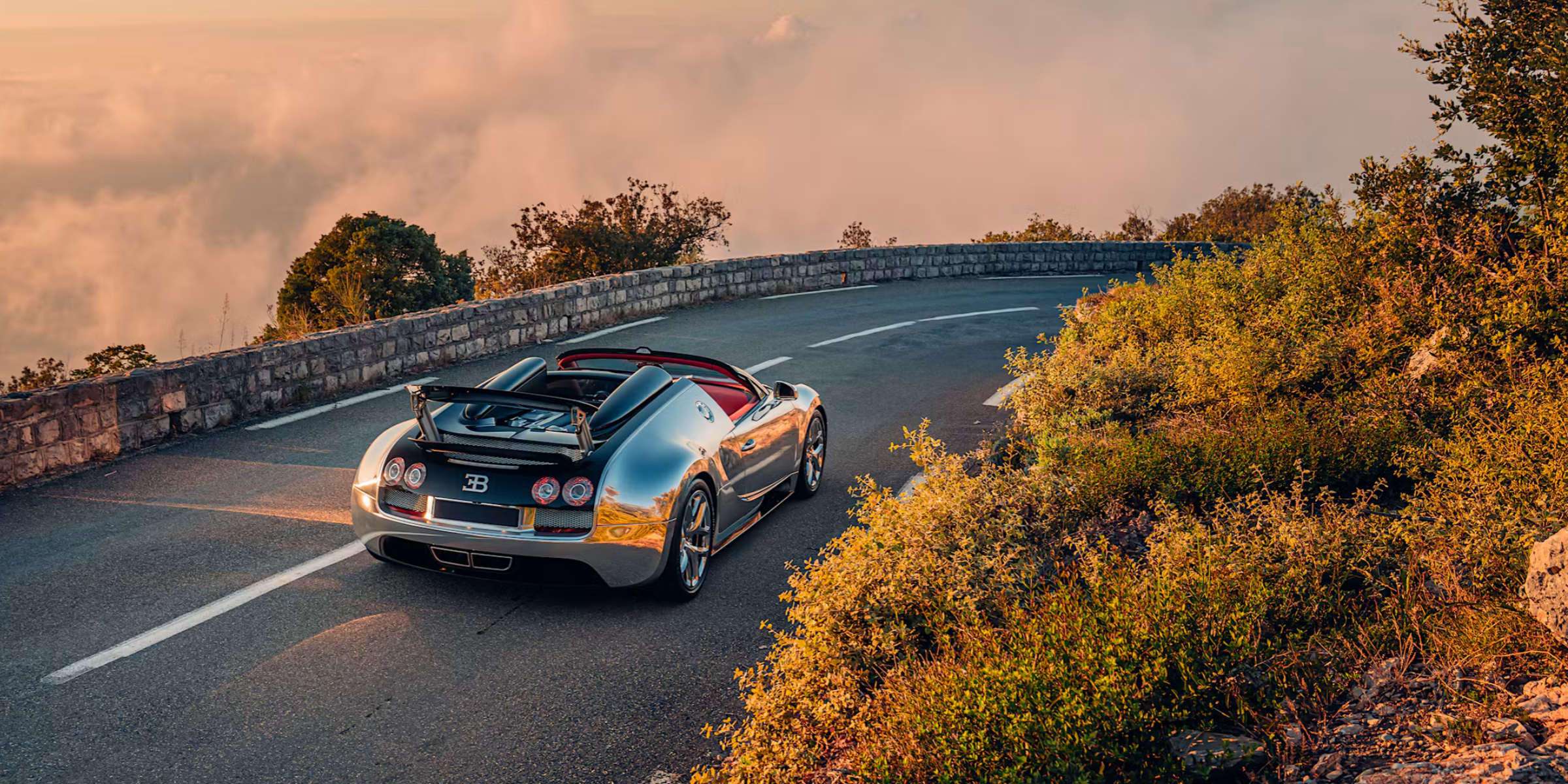
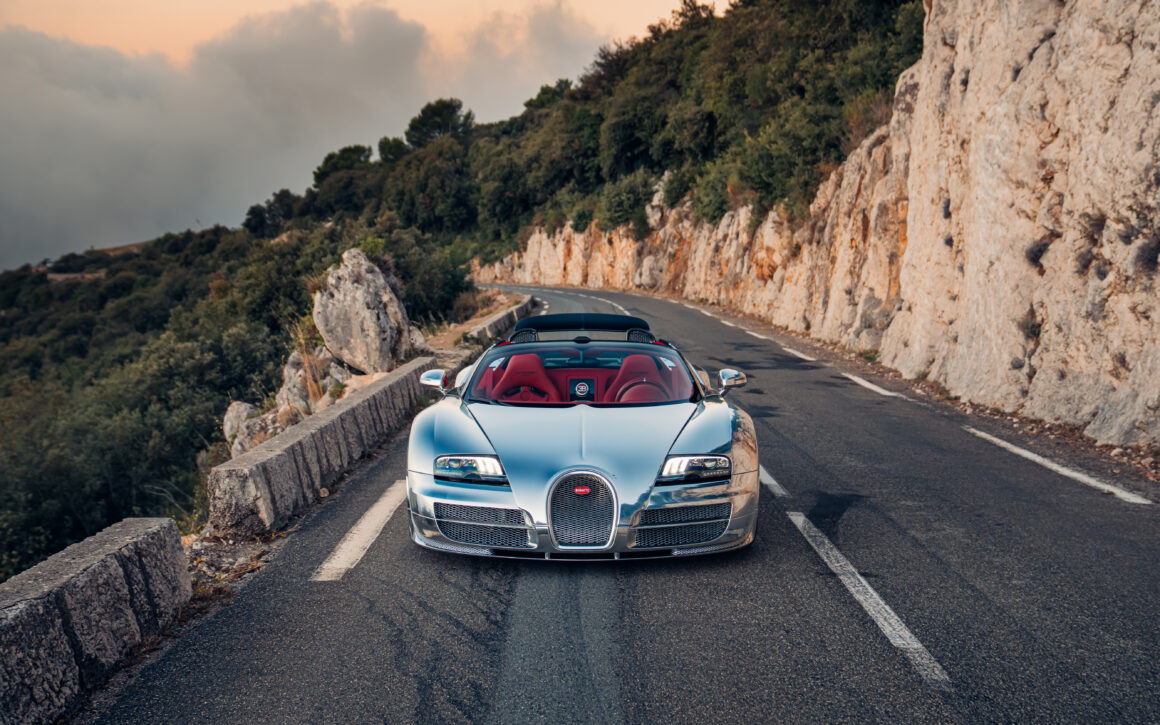
With a mirror-polished aluminium body, a Carmine Red leather interior and a record-setting 254 mph top speed, this restored Bugatti Veyron 16.4 Grand Sport Vitesse represents one of the most extraordinary expressions of the marque’s hypercar era.
Some automobiles command attention through their proportions or performance. Others possess a finish so unusual that the bodywork itself becomes the defining feature. This Bugatti Veyron 16.4 Grand Sport Vitesse achieves both, combining the engineering of a record-setting roadster with a mirror-polished aluminium exterior that turns the car into a moving sculpture.
Recently restored and now part of a private collection on the French Riviera, the car offers a glimpse into a period when Bugatti was redefining the limits of production-car performance. Its significance extends beyond its striking appearance: the Grand Sport Vitesse became the world’s fastest production roadster, reaching 254 mph in 2013 at Volkswagen’s Ehra-Lessien test track in Germany.
Fewer than 100 examples of the Grand Sport Vitesse were produced, making this particular car an exceptionally rare expression of the Veyron’s open-top engineering.
Aluminium Polished To A Mirror Finish
The car’s most distinctive feature is its exterior, formed from aluminium blocks weighing as much as 20 tonnes before being shaped into the Veyron’s bodywork and polished to a mirror-like finish.
The result is an almost liquid appearance. Rather than relying on conventional paint to create its visual identity, the metal reflects its surroundings across the body’s sculpted surfaces, emphasising the Veyron’s complex proportions and dramatic curves.
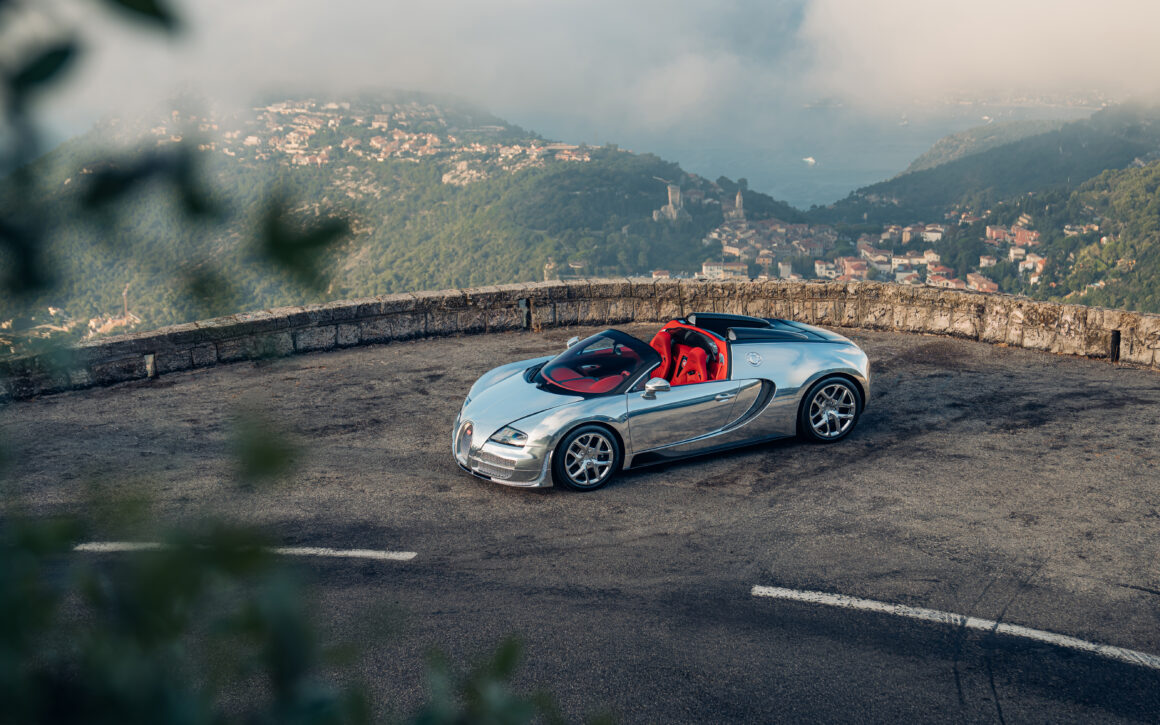
The finish also gives the car a different character depending on its environment. Under direct sunlight, the body becomes intensely reflective; against the architecture and landscape of the Mediterranean coast, it appears almost sculptural.
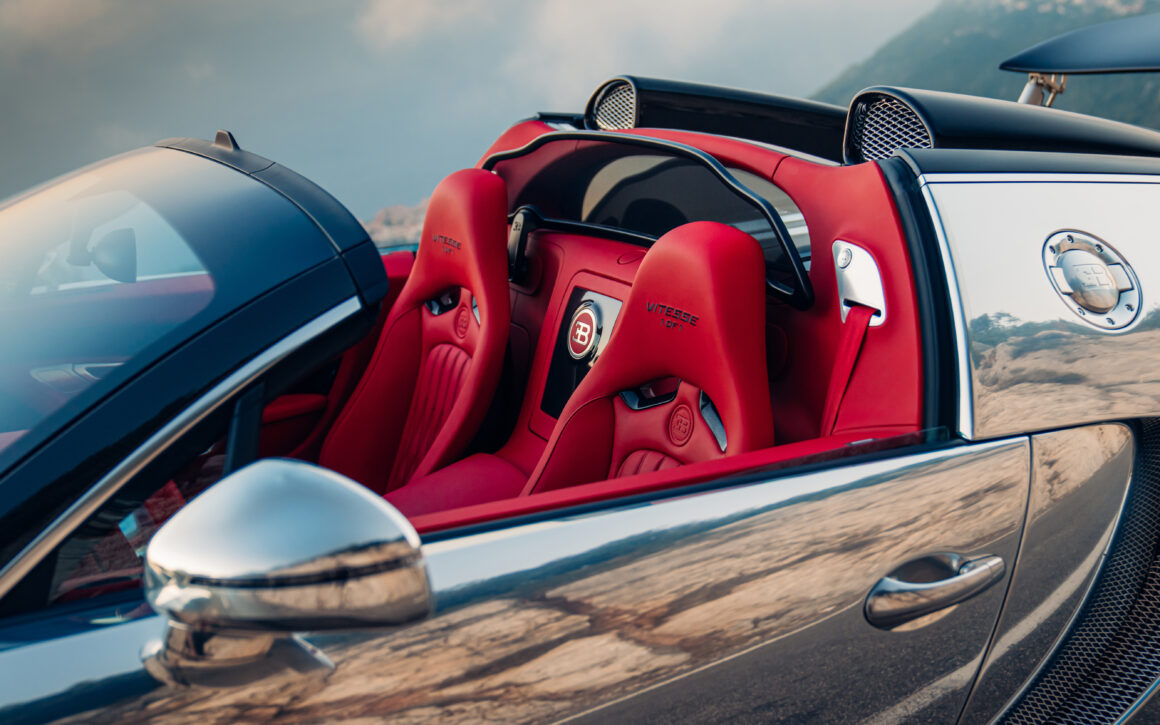
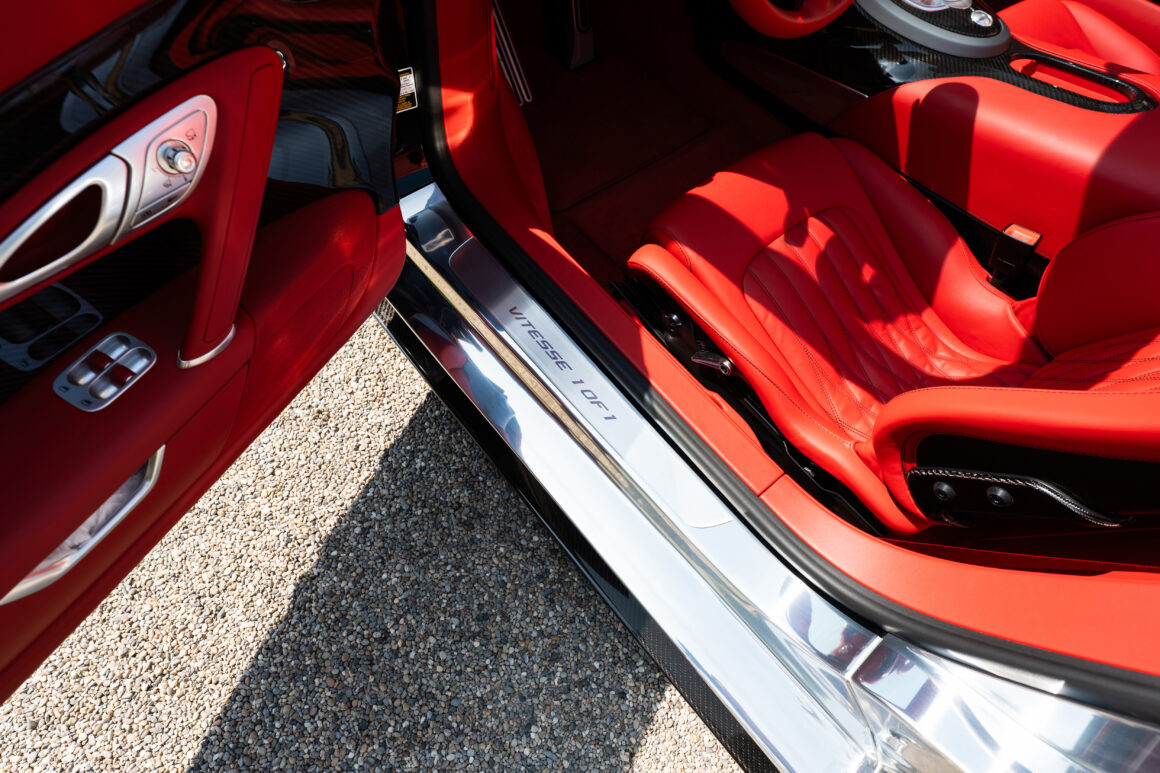
Inside, the original owner specified a Carmine Red leather interior, introducing a vivid contrast to the polished aluminium. The combination of cool metallic surfaces and rich red upholstery gives the car a distinctive visual identity without compromising its underlying mechanical purpose.
The specification reflects Bugatti’s longstanding ability to combine technical engineering with highly individualised design.
The Roadster That Reached 254 MPH
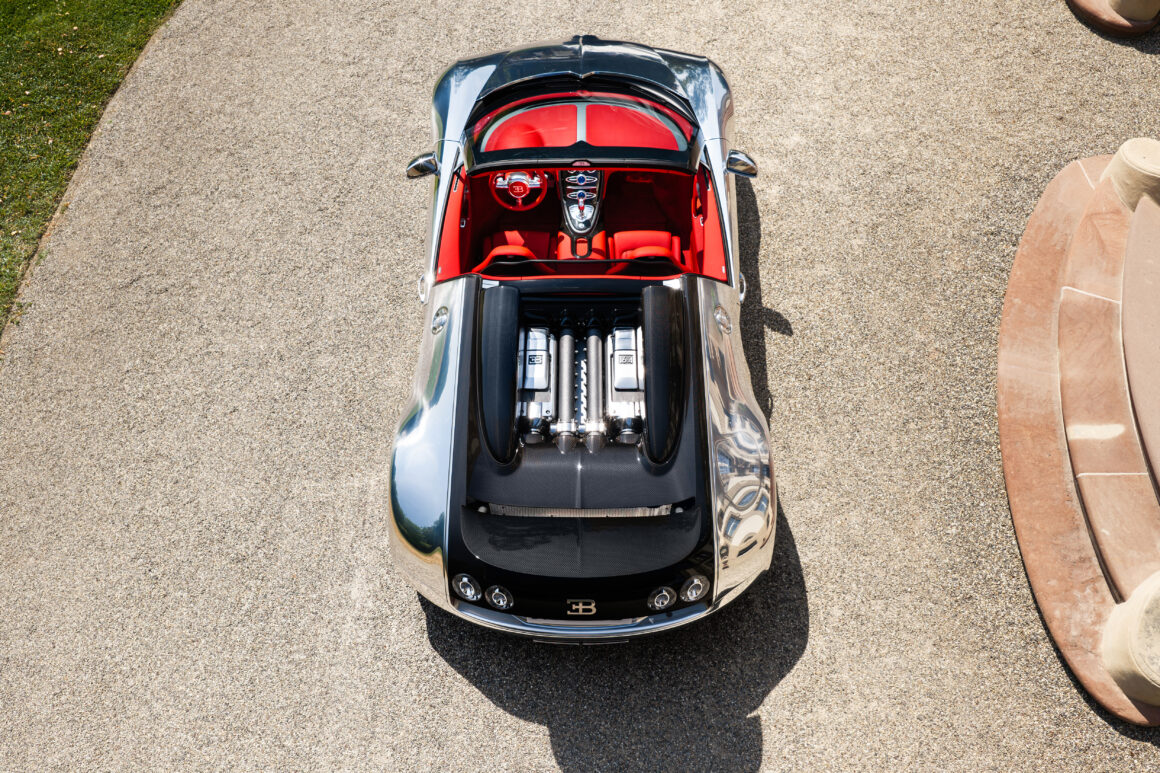
Beneath the bodywork sits an 8.0-litre quad-turbocharged W16 engine producing 1,184 horsepower. That represents a substantial increase over the original Veyron’s 1,000-horsepower output, translating the model’s extraordinary engineering into a more extreme open-top configuration.
The Grand Sport Vitesse was developed to deliver the performance of Bugatti’s flagship hypercar while allowing occupants to experience the engine and surrounding environment more directly.
Its achievement became particularly significant in 2013, when the model established a world speed record for a production roadster at 254 mph. The result placed it among the defining performance cars of its era, when manufacturers were competing to establish new benchmarks for speed and engineering.
The Veyron itself had already transformed expectations of a production automobile, becoming the first production car to cross the 1,000-horsepower and 250 mph thresholds. The Vitesse extended that achievement into open-top motoring.
Its performance was never simply about a large horsepower figure. At such speeds, aerodynamics, cooling, drivetrain engineering and stability become inseparable challenges. The Vitesse represented Bugatti’s effort to preserve the Veyron’s extraordinary capabilities while adapting the package for a roadster.
Returning Chassis 8.100 To Its Original Specification
The car’s recent restoration was undertaken through La Maison Pur Sang, Bugatti’s programme for authenticating, preserving and restoring historically significant models.
Identified as chassis 8.100, the Vitesse underwent a comprehensive certification process alongside refurbishment and reconfiguration. The work included removing later personalisation elements to return the vehicle to the specification in which it originally left Bugatti’s headquarters in Molsheim, France.
This distinction matters in the collector-car market. Individualisation can make a vehicle more personal to its owner, but subsequent changes may also move it away from the specification that defined it when new. Returning the car to its original configuration reconnects it with its documented history and intended design.
Bugatti’s programme also reflects a wider shift in the collector-car world, where provenance, authenticity and specialist restoration have become increasingly important considerations alongside rarity and performance.
For a car as unusual as this Veyron, preserving its original identity is part of protecting what makes it exceptional.
A New Chapter On The French Riviera
The restored Veyron now resides with a new owner on the French Riviera, a setting well suited to its combination of engineering drama and visual spectacle.
The Mediterranean coastline, with its winding roads, coastal architecture and concentration of luxury automobiles, provides a fitting backdrop for a roadster conceived to deliver extraordinary performance with the roof removed.
Its presence there also marks another stage in the car’s life. From its original specification to successive ownership and now specialist restoration, the Vitesse has moved through the different phases that shape a significant collector automobile.
Luigi Galli, a Bugatti certification expert, described the company’s role as guiding collectors through the car’s history and provenance, helping them identify significant additions to their collections and preserving authenticity for future generations.
That philosophy places the vehicle within a broader understanding of automotive collecting: exceptional cars are not simply purchased and stored. Their histories must be documented, their condition maintained and their original character understood.
More Than A Hypercar
The Veyron Grand Sport Vitesse belongs to a period in which Bugatti demonstrated how far the production automobile could be pushed without abandoning the demands of road use. Its W16 engine, extraordinary top speed and open-top configuration made it a technical statement. Its mirror-finished aluminium body gives it an identity that extends beyond performance.
The recent restoration adds another dimension, returning the car to its original specification while preserving the qualities that distinguish it from the already rare examples of the model.
For collectors, its appeal lies in the combination of engineering achievement, individual specification and careful preservation. For automotive enthusiasts, it remains a reminder of a time when the Veyron reset expectations for what a production car could accomplish.
On the French Riviera, this particular example begins another chapter, its polished body reflecting a landscape of extraordinary wealth and automotive ambition.
Some cars are remembered for the records they set. Others for the way they look. This Bugatti Veyron Grand Sport Vitesse has secured a place in both conversations.
At A Glance
- Model: Bugatti Veyron 16.4 Grand Sport Vitesse
- Chassis: 8.100
- Engine: 8.0-litre quad-turbocharged W16
- Power: 1,184 horsepower
- Recorded Speed: 254 mph, approximately 409 km/h
- Production: Fewer than 100 Grand Sport Vitesse examples
- Exterior: Mirror-polished aluminium
- Interior: Carmine Red leather
- Restoration and Certification: La Maison Pur Sang
- Current Location: French Riviera, France