|
Getting your Trinity Audio player ready...
|
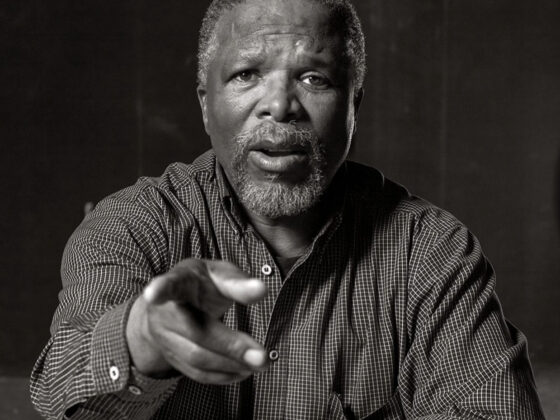
From Venda, self-taught artist and cultural entrepreneur Takalani Ligege is building a practice rooted in heritage, identity and the belief that an artist’s responsibility extends beyond the studio.
There is a particular kind of confidence that comes from knowing where you come from.
For Takalani Ligege, who lives and works in Venda, that confidence has become central to both his artistic practice and his wider work in the creative sector. Working across painting, linocut and other forms of printmaking, as well as sculpture, Ligege has developed a practice that draws deeply from his cultural surroundings while refusing to treat heritage as something fixed in the past.
For him, culture is alive — constantly evolving, being interpreted and reinterpreted by each generation. His work begins with the familiar: people, landscapes, memories, gestures, stories and cultural practices. But rather than simply reproducing these references, he transforms them through a contemporary visual language.
That approach is particularly significant for an artist working outside South Africa’s traditional cultural centres.
Ligege does not see his location in Vhembe as a disadvantage. Quite the opposite. His experiences exhibiting, working with other artists and developing his creative platforms have reinforced his belief that an artist can come from a rural community, speak to the world and remain deeply connected to where they come from. As he puts it, “My geographical location is not a limitation. It is part of my proposition.”

Finding a voice without a conventional path
Ligege is self-taught, a circumstance that has shaped more than his technical development. Without a conventional academic route into the arts, he became his own teacher — observing, experimenting, studying artists he admired, making mistakes and continuing to create.
The experience also gave him an understanding that becoming an artist is not something that ends with education.
“You have to remain a student for the rest of your life,” he says.
His education, however, was never limited to books or formal instruction. Growing up in Venda placed him inside a rich cultural landscape of stories, rituals, craftsmanship, music, patterns and people. Over time, he began to recognise that the environment around him already contained an enormous body of creative material.
The challenge was learning how to translate what he saw and felt into his own visual language.

The responsibility of the artist
For Ligege, the role of the artist extends beyond producing objects for exhibition or sale.
He believes artists are custodians of cultural heritage, and that cultural preservation becomes stronger when communities participate in telling their own stories. Who tells the story matters.
That conviction informs his work with other artists through Vendart International, as well as his involvement in developing opportunities for emerging creatives.
His philosophy is straightforward: talent alone is not enough. Artists also need access to knowledge, markets, networks, professional guidance and opportunities.
Rather than viewing mentorship as something separate from his own artistic practice, Ligege considers it part of it.
He does not want to create artists in his own image. He wants to help them discover their own voices, understand their value and learn how to operate professionally.
One person’s success, he believes, should create a pathway for another person.

Letting the idea choose the medium
Although Ligege works across different disciplines, he doesn’t see himself as belonging to a particular medium.
Instead, he allows the idea to determine the material.
Painting gives him the freedom to explore colour, atmosphere, emotion and movement. Printmaking demands greater reduction and discipline, forcing him to think carefully about line, texture, contrast and composition. Sculpture introduces another physical relationship with an idea through volume, weight, texture and presence.
“I am loyal to the idea,” he explains.
It is a revealing statement about his practice. Rather than allowing a particular medium to define what he can make, Ligege chooses the language that best communicates what he wants to say.

Beyond the individual artist
His career has gradually expanded his understanding of what an artist can be.
An artist, in Ligege’s view, does not have to exist solely inside the studio. They can build platforms, develop other artists, participate in cultural development and create economic opportunities.
That understanding has become increasingly important to his own journey.
Through exhibitions, art fairs, collaborations and his work developing Vendart, he has come to see artistic practice as something capable of contributing to a broader cultural ecosystem.
It is also why his ambitions extend beyond his own career.
He wants artists from communities that are frequently overlooked to have access to the wider art world without being required to abandon their origins.

Earth, memory and identity
The next chapter of Ligege’s practice is moving increasingly towards the relationship between people, land, memory and identity.
His exploration of Earth Bound considers rural South African communities and the cultural narratives embedded within the environments they inhabit.
He is interested in the ordinary things that carry extraordinary meaning: people working the land, traditional practices, landscapes, gatherings, clothing, movement, architecture and relationships between generations.
At the same time, he is expanding his work in printmaking and sculpture, with bronze becoming an increasingly important area of exploration.
The ambition is also becoming larger in scale.
Rather than creating isolated artworks, Ligege is interested in developing bodies of work that can exist simultaneously as exhibitions, collections and cultural narratives.

What is luxury to an artist?
For an artist whose work is deeply concerned with meaning and memory, Ligege’s definition of luxury is perhaps unexpectedly simple.
It isn’t about price.
“Luxury is time,” he says. It is craftsmanship, authenticity and having something made with intention and carrying a story.
He describes the luxury of being alone beside a dam, fishing rods in the water, experiencing the insignificance of one’s presence within the larger scale of existence.
There is also a connection between this philosophy and collecting.
A handmade artwork contains the decisions, imperfections, experience and emotion of its maker — qualities that mass production cannot easily reproduce. For Ligege, provenance and meaning therefore become part of the value of an artwork.
“A collector is not simply buying an object,” he says. “They are acquiring a piece of an artist’s journey, a cultural story and a moment in history.”

Building the path for those who follow
If Ligege has a message for the next generation of African artists, it begins with knowing their value and their story.
He believes African artists should not spend their careers trying to imitate what is happening elsewhere. Instead, they should investigate their own environments, histories and experiences and transform them into contemporary expressions.
But being African should never become a box.
Artists should be able to take their stories onto the international stage and participate as equals.
He also encourages artists to build networks and institutions alongside individual careers: share knowledge, collaborate, document their work, protect intellectual property and understand the business of art.
And above all, remain curious.
“Live curious and with passion.”
It is a philosophy that seems to describe Ligege’s own journey as much as the advice he offers others.

A legacy beyond the object
Ultimately, Ligege does not want his legacy to be measured only by the paintings, prints and sculptures he leaves behind.
He wants the opportunities he creates for other artists to become part of that legacy too.
He wants his work to contribute to the documentation and celebration of rural cultural life and broader African experiences without freezing those cultures in the past. He wants young artists to see that they can succeed without leaving their roots behind.
There is something quietly powerful about that ambition.
An artist making work is one thing.
An artist making space for others to follow is another.
And when asked how he wants to be remembered, Ligege offers a philosophy that feels less like a conclusion than an ongoing commitment:
“This is my mountain. This is my path. The mountain is my path.”
He is still climbing, still learning and still creating.
And, perhaps most importantly, he hopes the path becomes a little wider for those who come after him.