|
Getting your Trinity Audio player ready...
|
Now on view in Berlin, NIGHT transforms Mies van der Rohe’s iconic glass hall with unsettling figures, distorted monuments and reflections on collective memory.
Maurizio Cattelan has transformed Berlin’s Neue Nationalgalerie into something considerably more unsettled than an exhibition space.
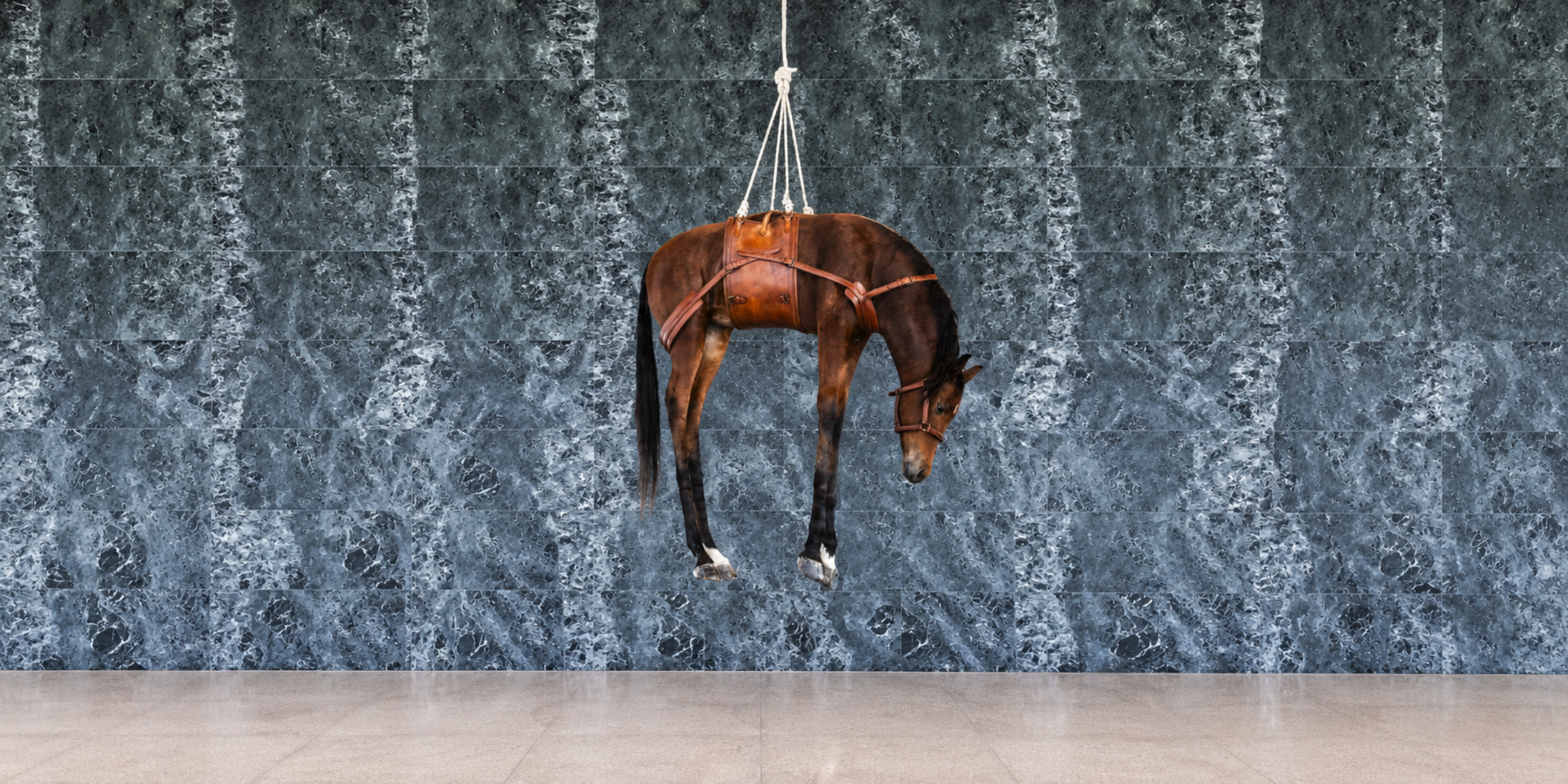
Now on view through 7 March 2027, NIGHT marks Cattelan’s first major solo presentation in Germany and forms part of the Preis der Nationalgalerie 2026. Inside Mies van der Rohe’s iconic glass-and-steel structure, the Italian artist brings together familiar symbols, historical references and new interventions that explore memory, mortality, power and uncertainty.
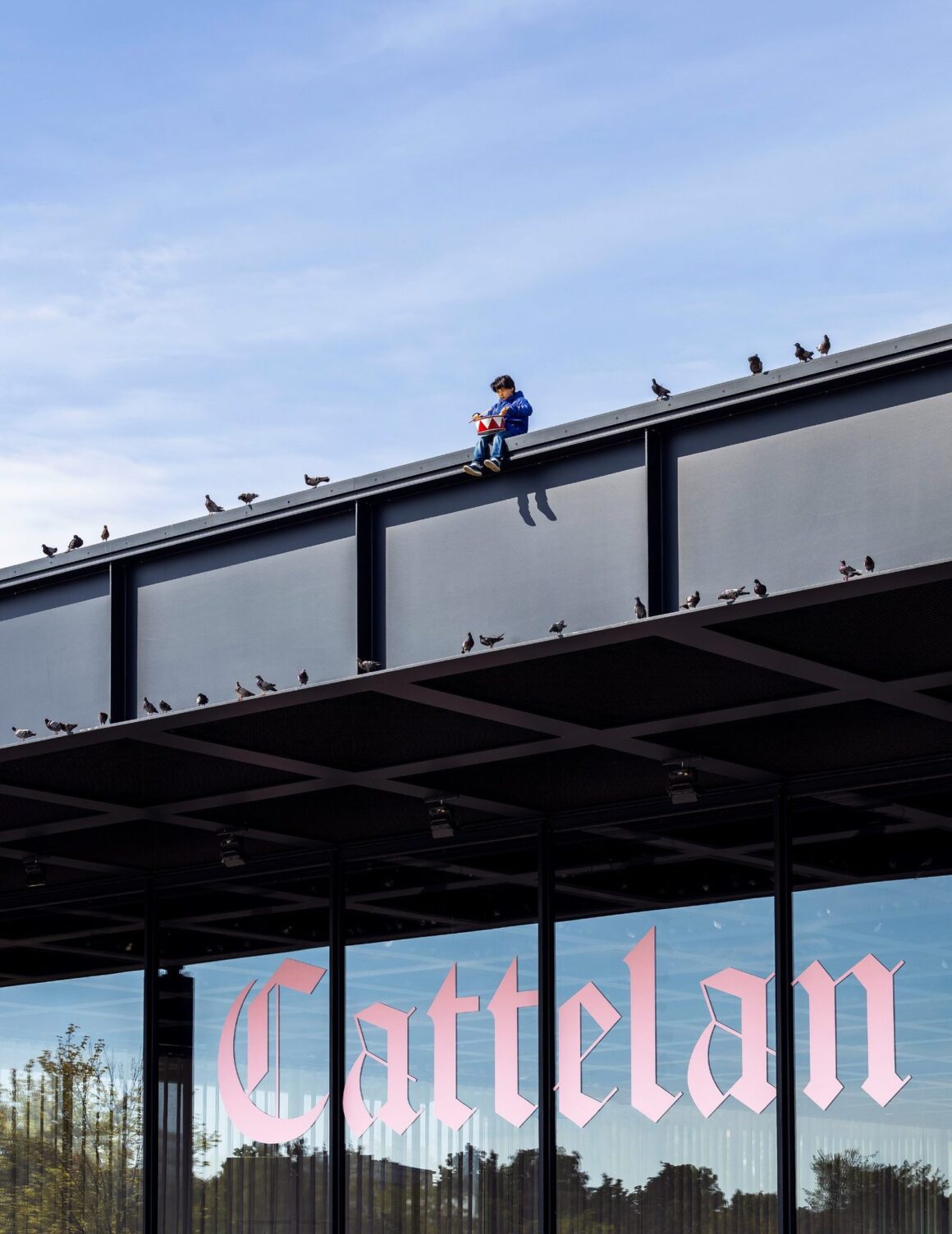
The architecture is not treated as a neutral container. Its severe geometry, transparency and monumental scale become part of the exhibition itself, creating an environment in which visitors encounter recognisable images in unfamiliar forms.
A Monument Becomes A Threshold
The exhibition begins before visitors enter the main hall.
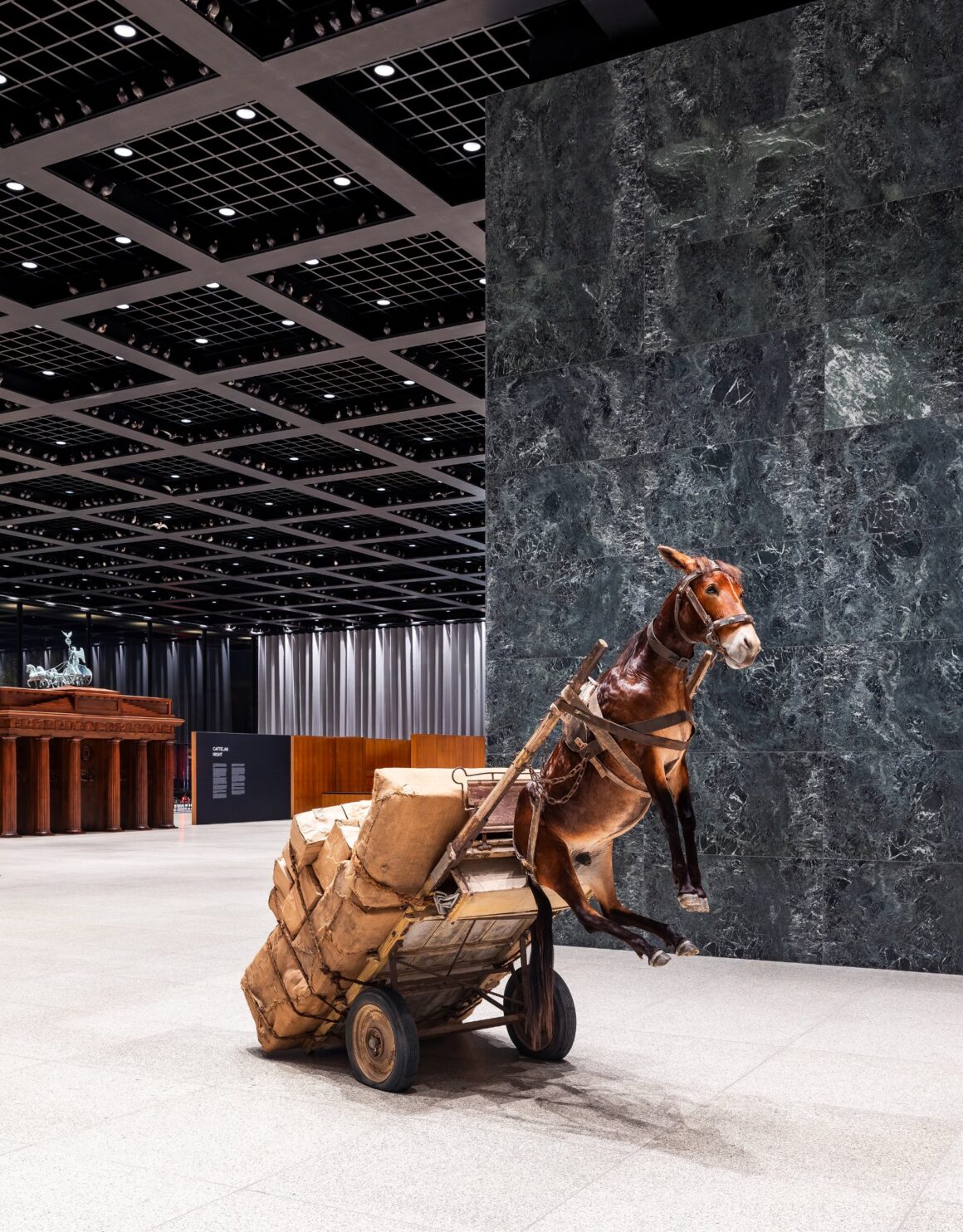
Works placed across the terrace and roof extend NIGHT into the surrounding city, while inside, Purgatory introduces one of its most recognisable interventions: a scaled-down Brandenburg Gate.
One of Germany’s most familiar monuments becomes a threshold rather than a fixed symbol. By changing its scale and context, Cattelan immediately establishes one of the exhibition’s central ideas: that images which appear permanent can acquire different meanings depending on how and where we encounter them.
In Berlin, that strategy carries particular weight.
The Uneasy Centre
At the centre of the glass hall stands Him, one of Cattelan’s most unsettling works.
At first glance, the sculpture appears to depict a kneeling child. Moving around the figure reveals the face of Adolf Hitler.
The work creates an encounter between apparent innocence and one of the most charged figures in modern European history, forcing the viewer to confront the instability of first impressions and the persistence of historical memory.
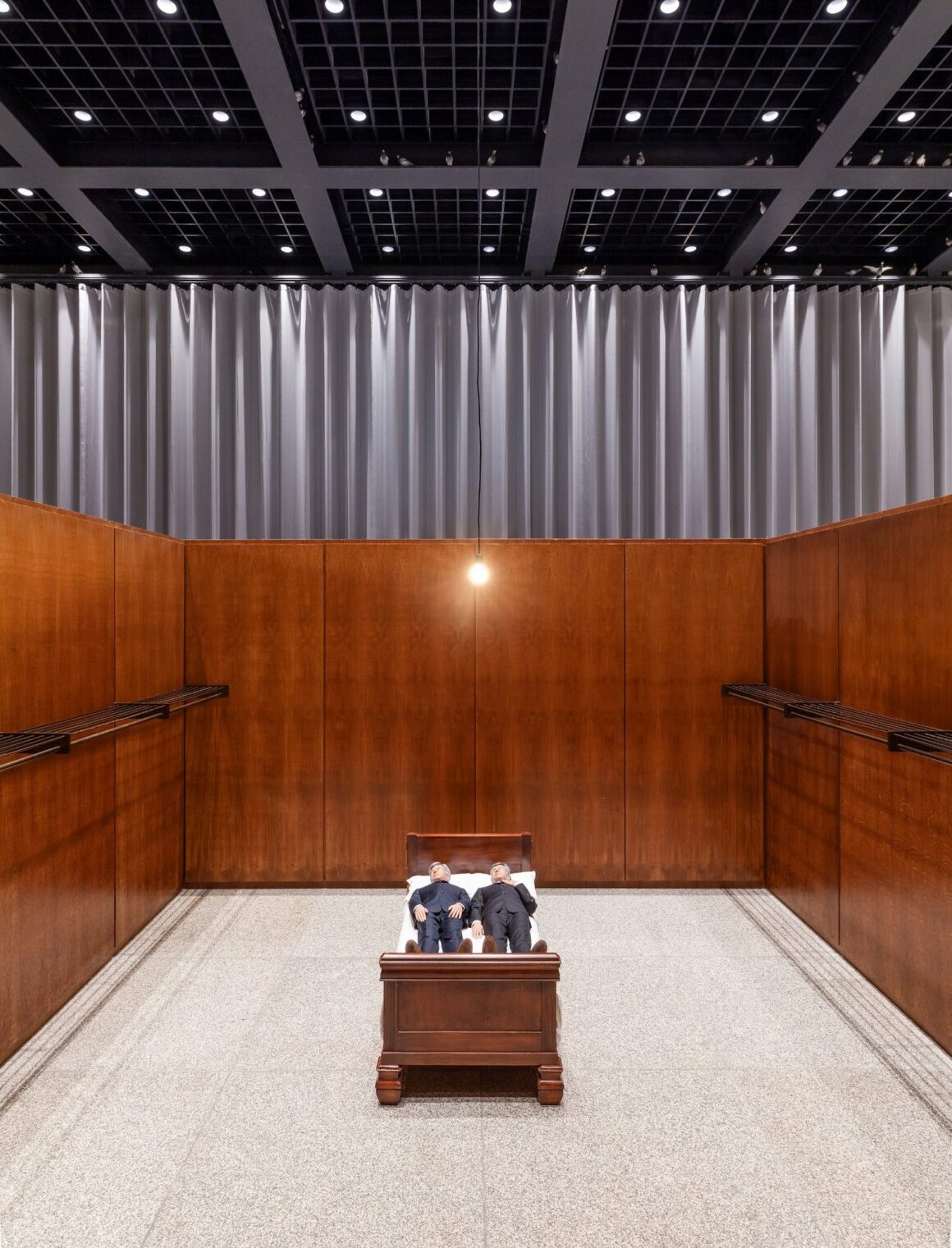
Nearby, Dawn introduces a suspended female figure in a cruciform position, while People places thousands of taxidermied pigeons across the ceiling structure.
Against the precision of Mies van der Rohe’s architecture, these interventions create an atmosphere of observation, vulnerability and uncertainty.
Berlin As Context
The setting adds another layer to NIGHT.
Berlin is a city where architecture, public monuments and historical memory remain deeply intertwined. Cattelan’s decision to place distorted or psychologically charged versions of familiar symbols inside one of the city’s defining modernist buildings creates a dialogue between history and the present.
The Neue Nationalgalerie itself is an exercise in monumental clarity. Cattelan introduces disruption into that order.
The result is an exhibition built around contrasts: immaculate architecture against unsettling imagery, transparency against concealment, historical recognition against uncertainty.
When The Museum Becomes Part Of The Work
Curated by Lisa Botti with Klaus Biesenbach, in close collaboration with Cattelan, NIGHT reduces the distance between artwork, architecture and exhibition design.
The Neue Nationalgalerie becomes part of the experience rather than simply its backdrop.
Visitors move through a sequence in which sculptures, monuments and architectural space continually alter one another. The building frames the works, while the works simultaneously change how the building is perceived.
NIGHT is now open at the Neue Nationalgalerie in Berlin and remains on view until 7 March 2027.
Cattelan has taken one of Berlin’s most recognisable modernist spaces and introduced a world of historical unease, theatricality and ambiguity into its geometry.
The architecture remains perfectly still. Everything around it becomes uncertain.