|
Getting your Trinity Audio player ready...
|
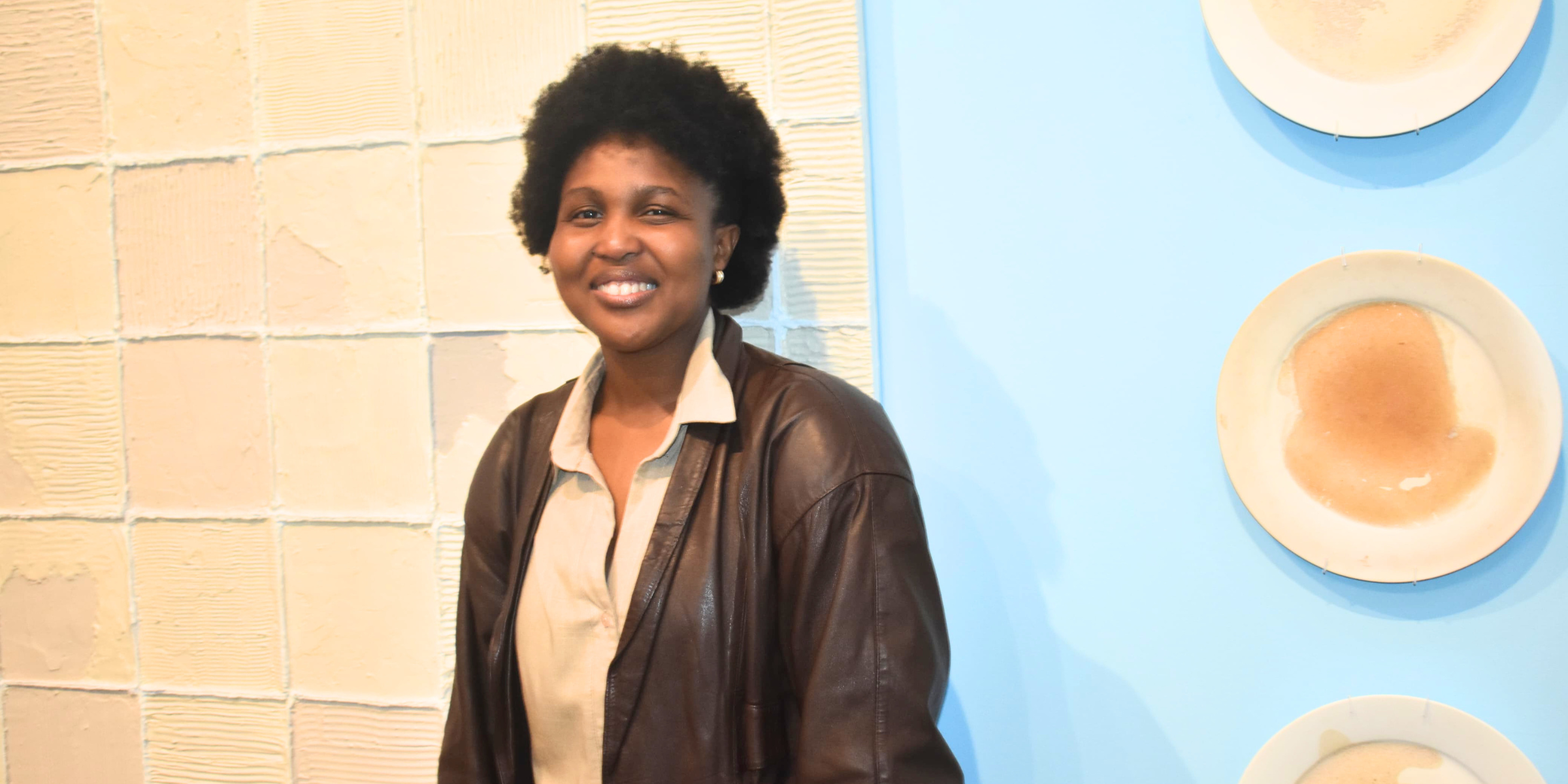
The Botswana-born artist transforms domestic spaces, familiar objects and traces of everyday life into meditations on memory, identity and belonging.
There is a particular kind of memory that lives in objects.
Not necessarily the treasured heirloom carefully wrapped and stored away, but the things encountered every day: a wall, a doorway, a piece of furniture, a kitchen surface, an appliance, the architecture of a childhood home.
We rarely think of these things as archives.
For Kelebogile Marope, they can be.
The Botswana-born artist has developed a practice that looks closely at the relationship between memory, identity and the spaces we inhabit. Working across sculpture, drawing and mixed media, she turns her attention towards the domestic environment and the traces of everyday life, asking how ordinary spaces accumulate meaning over time.
It is a quiet investigation, but one with considerable depth.
Marope is interested in what remains.
The marks left by objects. The evidence of use. The relationship between the body and architecture. The memories attached to spaces that can appear completely unremarkable to someone else.
Her work asks us to look again.

THE HOME AS AN ARCHIVE
Home is one of the most familiar concepts we have, yet it is remarkably difficult to define.
It can be a physical structure, a childhood landscape, a country, a room, a collection of objects or simply a feeling of recognition.
For Marope, domestic environments provide an entry point into these complicated ideas of belonging.
Her practice considers how homes, schools and institutions become vessels for personal and collective memory. The architecture surrounding us is never entirely neutral. We move through it, develop routines within it and attach experiences to particular spaces.
Eventually, those spaces become part of who we are.
This relationship between place and memory is particularly important in understanding Marope’s work.
Born in Ramotswa, Botswana, she later studied in South Africa, completing a Bachelor of Fine Art and Master of Fine Art at Rhodes University. Her experiences across these environments have contributed to a practice concerned with the ways places shape our sense of identity.
The physical environment becomes something more than a backdrop.
It becomes part of the story.

THE ARCHAEOLOGY OF USE
There is an archaeological quality to Marope’s approach, but her excavation sites are not ancient ruins.
They are the spaces of ordinary life.
A household object can carry evidence of the people who used it. A surface can record years of repetition. An architectural detail can trigger a memory that has remained dormant for decades.
This is where Marope’s interest in everyday materials becomes particularly compelling.
Objects that would normally disappear into the background are brought forward and reconsidered.
The ordinary becomes evidence.
The familiar becomes strange.
And something as simple as an object or surface begins to suggest a much larger story about labour, routine, family, movement and time.
Rather than treating memory as something purely psychological, Marope gives it a physical vocabulary.
It can occupy a room.
It can exist in a material.
It can be embedded in a surface.
It can leave a trace.
WHAT WE LEAVE BEHIND
Perhaps the most powerful element of Marope’s work is her interest in absence.
A physical object can disappear while its imprint remains.
A person can leave a house, yet the house continues to contain evidence of their presence.
A familiar space can change completely while still carrying memories of what it once was.
This tension between presence and absence runs through her practice.
The object itself becomes less important than the story surrounding it.
That opens up an interesting question: what exactly constitutes an archive?
We often associate archives with official records, photographs, documents and institutions.
Marope suggests that an archive can also be domestic.
It can exist in the places where people cook, clean, rest, gather and live.
The archive can be something as ordinary as a mark on a wall.

BETWEEN PLACES
Marope’s relationship with Botswana and South Africa adds another layer to this exploration.
Her work does not reduce belonging to a single geographic location. Instead, it allows the idea of home to remain fluid.
There can be more than one place that shapes you.
There can be memories attached to different environments, different stages of life and different versions of yourself.
The movement between places also changes the way we perceive them.
A space that once felt completely familiar can suddenly feel different when we return to it.
The body notices these changes.
The height of a surface.
The proportions of a room.
The position of a doorway.
The distance between objects.
These details can become surprisingly powerful triggers of memory.
Marope’s work gives those details a language.
SCULPTURE WITHOUT THE MONUMENT
Sculpture has traditionally carried an association with permanence and monumentality.
Statues commemorate people. Monuments preserve events. Public sculpture occupies space with authority.
Marope takes sculpture somewhere much more intimate.
Her subjects are often drawn from the environments of everyday life.
That shift is significant.
Instead of asking us to remember a famous figure or historic event, her work encourages us to consider the seemingly insignificant evidence of our own lives.
What objects would remain if our homes were suddenly emptied?
What traces would tell someone else that we had lived there?
What would they understand about us from the things we touched every day?
These questions give the work an emotional dimension without requiring spectacle.
A MOMENT OF RECOGNITION

Marope’s recognition with the 2026 FNB Art Prize places her practice within a much larger conversation about the development of contemporary African art.
She becomes the first artist from Botswana to receive the award, joining previous recipients including Cedric Nunn, Kudzanai Chiurai, Mocke J van Veuren, Nelisiwe Xaba, Portia Zvavahera and Turiya Magadlela.
The award also includes a cash prize and a solo exhibition at the Johannesburg Art Gallery scheduled for 2027.
But while the recognition marks an important moment in Marope’s career, the more interesting story lies in the work itself.
Because there is something particularly relevant about an artist receiving significant institutional recognition for looking closely at the things most of us overlook.
The domestic.
The familiar.
The everyday.
The things we assume don’t need to be remembered.
LOOKING AGAIN
There is a certain patience required to engage with Marope’s practice.
Her work does not demand attention through spectacle alone.
It rewards observation.
You begin with an object or a surface and then start thinking about everything that might have happened around it.
Who used it?
Who touched it?
Who lived there?
What happened in that room?
What has disappeared?
What remains?
Those questions move the work beyond the physical.
Marope is ultimately exploring the relationship between place and memory, object and experience, presence and absence.
And perhaps that is why the archaeology metaphor feels so appropriate.
She is excavating the evidence of lives that might otherwise disappear into the ordinary.

THE STORIES WE LEAVE BEHIND
At a time when contemporary art is increasingly concerned with identity, history and the politics of place, Kelebogile Marope offers a more intimate proposition.
Look closer.
Look at the spaces around you.
Look at the objects you have stopped noticing.
Look at the marks created through years of living.
They may contain more history than we realise.
For Marope, the archive isn’t necessarily somewhere distant.
It may already be sitting inside the home.
And sometimes, the most revealing stories are the ones hiding in plain sight.